 |  |  |  |  |  |  |  |  |


| ||||||||||
| | |||||||||
|
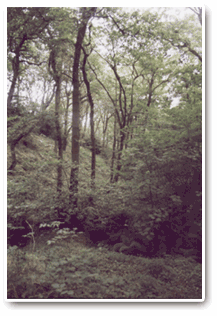
NEW HALL WOOD There is no known documentary evidence available proving the existence of New Hall Wood prior to 1600. However, its location in a relatively steep sided stream valley together with its rich flora, which includes many species normally restricted to ancient woodland, is typical of ancient woodland sites. At one time New Hall Brook drove a "Clack Mill" used for grinding meal. It is estimated that this mill dated back to approximately 1296. Traces of the dam earthworks can still be seen in the privately owned part of the wood. The woodland at the site is semi-natural and broadleaved. It is basically an Oak/Birch woodland but also contains Ash, Beech, Willow, Holly and a considerable amount of Sycamore, plus Alder in the wettest areas. There is a significant amount of Hazel in the understorey. As well as woodland, the site includes the stream and wet nutrient-rich areas known as flushes.
A well-used public footpath runs through the length of the wood, giving access from Stocksbridge to the open countryside beyond. This path is wide and surfaced making it suitable for use by pushchairs and people in wheelchairs. Parking is available on Hawthorne Avenue which runs through the wood. Under the Fuelling a Revolution programme, woodland restoration and access improvement work is taking place to restore New Hall Wood to its former glory and to maximise its potential as a recreational and educational resource. Some thinning and group felling will be carried out in order to create a more varied woodland structure and to encourage the regeneration of native trees such as Oak, Ash, Hazel and Alder. Sycamore, a non-native and highly invasive species, will be particularly favoured for removal. Coppicing may be produced in selected areas and some new planting of Oak, Birch and Hazel may be carried out in open areas on the eastern side of the site. Measures will also be taken to improve the habitat value of wetland areas. Small areas of Japanese Knotweed, another non-native and highly invasive species, are present at the site and these will be controlled. Access to the wood will be improved by upgrading the path system and creating resting places with seating. Work is also required to reduce problems of litter and fly tipping. Finally, the potential of the site as an educational and recreational resource is being developed through guided walks, events relating to the natural history and historic interest of the site, children's events and practical management tasks. Other nearby Heritage Woodlands are:
|