ACCESS IMPROVEMENTS
|
|
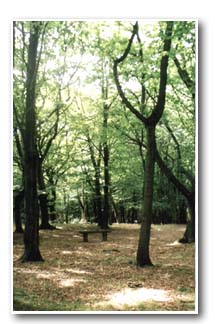
Seating allows visitors to take time to enjoy the woodlands.
|
Although all 35 of the Heritage Woodlands already have free public access and are well used by local people, work is being carried out under the Fuelling a Revolution programme both to improve access further and to enhance the quality of the woodlands for visitors. This work will ensure that the woods are even better used than at present and that they can be enjoyed and fully appreciated by all sectors of the community.
Whilst the programme seeks to open the woodlands up to as wide a range of people as possible, not all uses of the woodland are desirable, either in terms of their effect on the woodland itself or on other visitors. Some of the access work around and within the woodlands therefore seeks to reduce the frequency of such activities. Less desirable uses of the woodlands include litter and fly-tipping, dumping of cars, air gun use, vandalism, and damage to footpaths and vegetation by motorcyclists, off-road vehicles and to a lesser extent by horse riders and mountain bikes. The degree to which the woods suffer from these pressures varies widely, largely in relation to the proximity of the woodland to densely populated urban areas.
Access improvements under the Fuelling a Revolution programme vary from site to site, with access to some sites being encouraged more actively than to others. In some of the woods, the character of the more remote and inaccessible areas will be maintained by discouraging access.
Typical types of access work being carried out within the woodlands are described below.
- Footpath Improvements are taking place in the vast majority of the woodlands. The quality of selected footpaths is being improved by means of surfacing and drainage, and steps are being installed in a number of places, particularly where soil erosion has occurred. As part of this work, some path networks are being rationalised, with waymarking being installed where appropriate. Some provision for horse riding and cycling has been or is being made in some of the woods, particularly through such initiatives as the Trans-Pennine Trail, which serves a number of the woodlands.
|
|
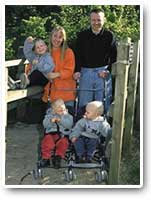
Access for all is an important part of the Fuelling a
Revolution programme.
|
- Access for All is a particular focus of the work within the woodlands, with access for wheelchair users and families with pushchairs being improved wherever practical. However, whilst efforts are being made to allow people of all abilities to enjoy and appreciate the woodlands, this is not possible within every part of every woodland. As with many other ancient woodlands, many parts of the Heritage Woodlands are on steep slopes or have areas with poor drainage. The flattest woods are by and large, those with the greatest potential for access for wheelchair users and pushchairs. Detailed information on access to the individual Heritage Woodlands is given elsewhere on this website.
- Access Points are being rationalised and provided with gates and stiles. Where appropriate, these are being designed to allow access by people in wheelchairs and families with pushchairs, whilst at the same time keeping out motorbikes and other vehicles.
Once this has been done, the use of other access points will be discouraged.
|
|
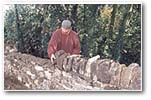
Restoration of woodland boundaries sometimes includes the
reconstruction of stone walls.
|
- Site Boundaries are where necessary being constructed or restored. The types of boundaries around the 35 woodlands vary widely and include hedgerows, stone walls, and fences of varying designs. Restoring these boundaries allows more effective woodland management, ensures that undesirable uses of the woodland are minimised, and in many cases restores ancient boundary features. The type of work required obviously varies with the type of boundary but includes stone walling, fencing, hedgerow planting and hedge laying, an ancient hedge management technique.
- Seating is being installed at strategic points within the woodlands in order to provide a place where visitors can rest and enjoy the woodland environment.
|
|
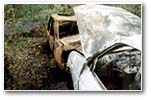
Restoring the woodlands has meant the removal of rubbish,
including in some cases, dumped cars.
|
- Rubbish Removal including the removal of litter, fly tipping, garden refuse and dumped cars is being undertaken at regular intervals in order to increase the appeal of woodlands as places to visit.
- Interpretation and Education Work is taking place in the woodlands, at least in part to encourage community involvement in the care and management of the sites. For further information on this, see the sections on Education and Interpretation the Events Diary and the section of this website specially targeted at schools.
  
|
|