NON-WOODLAND HABITATS
As well as woodland, many of the Heritage Woods also contain areas of other habitats, including scrub, grassland, heath and wetland. These additional habitats often greatly increase the range of plant and animal species found.
|
|
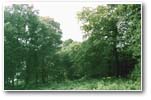
A Bracken dominated glade close to the southern end of Woolley Wood.
|
Glades
A number of the woodlands contain glades of various sizes. The vegetation
of these varies according to location and soil type, but can include
Bracken,
Bramble,
acid grassland and heathland, as well as areas of woodland ground
flora with ancient woodland indicators.
Scrub
Developing woodland, often dominated by Oak and Birch and shrubs
of Elder
and Hawthorn
provides an important habitat for wildlife.
|
|
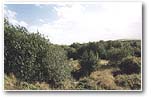
Like some of the other Heritage Woodlands, Cliffe Wood has significant areas of grassland and scrub.
|
Grassland
This varies according to the soil type and past management of the area.
Acid grassland is the most common type. As well as grasses such
as Wavy
Hair-grass, Sheep's
Fescue and Creeping
Soft-grass, this supports other acid loving plant species, including
Field
Woodrush, Heath
Bedstraw and Heather.
Some of these areas of grassland, for example that at Canklow
Wood are either currently grazed or were grazed until relatively
recently. Following the cessation of grazing, these open areas are
being colonised by young trees, particularly Silver
Birch. In addition, Bracken
can become a dominant species in some grassland areas where it can
have the effect of stifling some tree regeneration.
Particularly species rich areas of meadow can be found on the northern edge of Rollestone Wood as well as in association with other sites in the Gleadless Valley.
Cliffe Wood has a number
of mown grassland areas, especially along the route of the old Barnsley
canal. Small, open areas of marshy grassland at this site are of
particular interest, supporting Common-spotted
Orchid, Greater
Reedmace and Lesser
Pond-sedge.
|
|
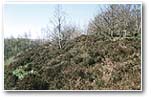
Small areas of heathland are found within some of the Heritage Woodlands.
|
Heathland
Areas of heathland dominated by a mixture of Heather
and Bilberry
can be found at some of the sites, for example in the glade at Wickersley
Wood and in the open area between Wheata
Wood and Prior Royd. These heathland areas are distinct from
upland moorland in being dry and without the formation of peat.
Wetlands
|
|
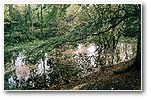
Some of
the Heritage Woodlands have wet areas such as this pond in
Scholes Coppice.
|
Wet areas of open ground occur at a number of the sites.
They include nutrient-rich areas known as flushes, which
often result from the presence of springs. These are often dominated
by Willow, over a ground flora of Tufted
Hair-grass, Soft
Rush, Cotton
Grass and mosses typical of wet places, for example Sphagnum.
Treeton Marsh on the edge of Hail
Mary Hill Wood has areas of open water surrounded by Greater
Reedmace, Great Willowherb, Common
Reed, Reed
Canary-grass and Soft
Rush, with Marsh
Marigold, Water
Plantain, Angelica,
Bittersweet,
Water
Forget-me-not, Gypsywort
and the non-native but highly invasive species, Himalayan
Balsam.
|
|
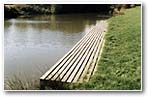
Areas of open water adjoin a few of the Heritage Woodlands.
|
Open Water
Areas of open water are found on the edges of a number of the sites, in particular Cliffe Wood and Hail Mary Hill Wood.