

The ProgrammeThe WoodlandsLocation MapEventsNewsSchoolsChildrenInteractiveFeedback
The ProgrammeFuelling a Revolution
More information - Buck Wood
  visiting the wood
» landforms, rocks and soils
  history and heritage
  plants and trees
  vegetation
  birds and animals
  educational use
  woodland restoration and
   management work
BUCK WOOD - THE SITE

GEOLOGY
The rocks underlying the woodlands of the Gleadless Valley belong to the Coal Measures and were formed between 325 and 280 million years ago, during the Carboniferous period of geological time.

The rocks consist of alternating bands of shale and sandstone, with shales generally dominating.

A thin band of coal runs through the upper part of Buck Wood.

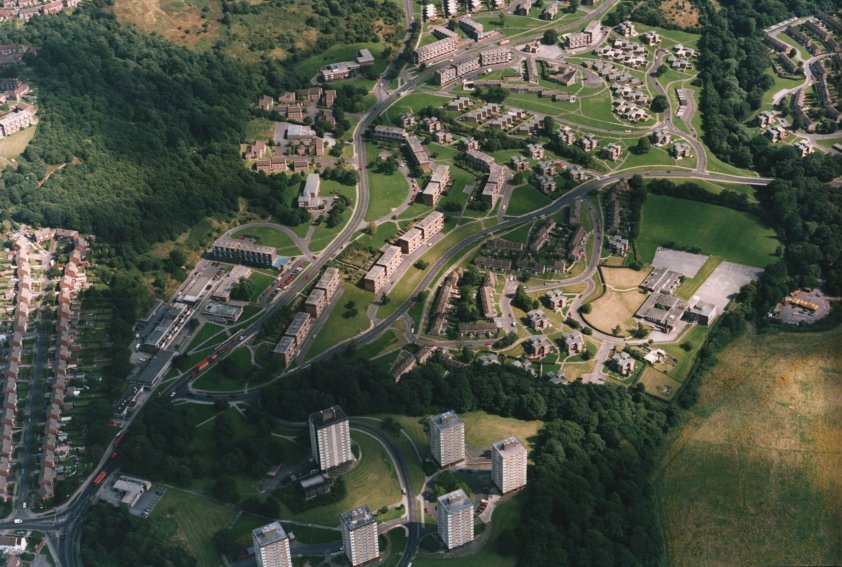
Aerial view of Buck Wood
An aerial view of Buck Wood (far left), clearly showing the mix of housing, roads and open spaces that charcterises the Gleadless Valley. Image courtesy of the Gleadless Valley Wildlife Trust.

LANDSCAPE
Buck Wood is one of the highest woodlands in the Gleadless Valley. It lies on a moderately steep south-west facing slope, overlooking Newfield Green shopping centre.

A small stream runs down the eastern edge of the wood. This is a tributary of the Meers Brook, the main watercourse through the Gleadless Valley.

SOILS
Three main soil types underlie the woodlands of the Gleadless Valley: acidic soils, neutral soils and waterlogged soils. The first of these is the most widespread in Buck Wood.

Thin dry 'acidic soils' occur over sandstone, particularly on higher ground, as well as over shales on steep slopes. The depth and acidity of the soils is strongly affected by slope, the thinnest and most acid soils being found on the most steeply sloping sites.

Neutral soils are mainly found on flat to moderately sloping ground over shales. They vary in depth and clay content and also from dry to seasonally wet, the wettest areas being on stream banks, in valley bottoms and by springs and wet nutrient rich areas known as flushes.

Waterlogged soils are found in association with streams, springs and flushes. They occur mainly over shale, particularly where this meets sandstone strata. These conditions occur on the valley slopes as well as in the valley bottoms and by streams. Some of the springs are wet all year round but the flushes are more seasonal.

VIEWPOINTS

The upper edges of Buck Wood offer extensive views both across the rest of the Gleadless Valley and across Sheffield towards the Peak District moorlands.

backBack to Topback