|
ANIMALS
OF THE HERITAGE WOODLANDS
The Heritage Woodlands support a wide range of wildlife, some
of which is either found only in ancient
woodlands or which is otherwise uncommon in South Yorkshire.
The irregular shape of some of the woodlands results in them having
a long woodland edge relative to their area. This enhances their
value for wildlife; edge habitats frequently being richer and more
diverse in both plants and animals than the communities they lie
between. The juxtaposition of woodland edge and open ground enables
birds and mammals to exploit the food resources of the grasslands
while retaining the protection of the woodland.
|
|
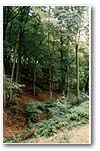
Glades
such as this one in the centre of Gibbing Greave often support
a large number of insects and other invertebrates.
|
Invertebrates
The different woodland types, together with
the other habitats found within the Heritage
Woodlands support a wide range of invertebrates, a number of which
are ancient woodland indicators. For example, over 500 different invertebrates
have been recorded at Canklow Wood,
including a number of nationally scarce species. The best Heritage
Woodlands for invertebrates tend to be those with a varied woodland
structure, an abundance of dead and dying wood, and areas of wetland.
Another factor that increases the number and range of invertebrates
is the presence of open habitats such as glades and grassy rides
within or adjacent to the woodlands, especially where these are
south facing. For example, the south facing glades of Buck
Wood in the Gleadless Valley make this site particularly
suitable for invertebrates requiring warm sheltered conditions,
such as soil-nesting solitary bees, wood-nesting solitary wasps
and the butterflies, Meadow Brown and Small Skipper.
Other butterflies and moths recorded in the woodlands include
Holly Blue, Common Blue, Meadow Brown, Small Skipper, Small White,
Purple Hairstreak, Speckled Wood, Orange Tip, Green-veined White,
Comma, Small Tortoiseshell, Peacock, Red Admiral and Dotted Border
Wave.
The streams that flow through a number of the woodlands add a
further habitat for invertebrates, being a home for fresh water
shrimps, water beetles, caddis fly, stonefly and mayfly.
|
|
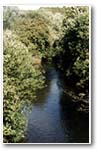
The
River Dearne, which flows past Cliffe Wood, was at one time
one of region's most polluted rivers, but now supports brown
trout.
|
Reptiles,
Fish & Amphibians
A number of amphibians, fish and reptiles have been recorded from
one or two of the sites. For example, the Treeton Marsh area of
Hail Mary Hill Wood supports
Grass Snake, Three-spined and Ten-spined Sticklebacks, Smooth Newt
and Common Frog. The pools and small lakes close to the southern
edge of Cliffe Wood contain
Carp, Perch, Bream and Tench. The River Dearne, which forms part
of the southern boundary of this woodland and which was at one time
one of the most polluted rivers in the region,
now supports Brown Trout.
|
|
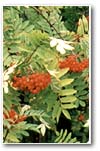
The
berries of the Rowan or Mountain Ash, though poisonous to
humans, are an important food source for birds.
|
Birds
The range of birds recorded in the Heritage Woodlands is especially
wide for an urban area and includes a number of species that are relatively
uncommon or declining in numbers. As for invertebrates, the range
of birds found on a site reflects the mix of habitats found. The greatest
variety of bird species tends to be in woodlands with wet areas, in
those with abundant mature trees for hole-nesting birds, and in those
with a well-developed shrub layer.
Birds which favour areas of more mature woodland include Blackcap,
Sparrowhawk, Jay, Treecreeper and Tawny Owl. Standing deadwood provides
nesting sites for Green Woodpecker, Greater-spotted Woodpecker,
Blue Tit, Great Tit and Nuthatch.
In contrast, species such as Wren, Chiffchaff, Turtle Dove, Song
Thrush, Linnet, Grey Partridge. Chaffinch, Lesser Whitethroat, Yellowhammer
and Kestrel prefer woodland edges and clearings, as well as adjacent
hedgerows, open ground and areas of scrub. At some of the more urban
sites, many of these birds supplement their food supply from adjoining
residential areas. These more open areas are also important for
feeding Jays and Magpies and as a venue for Woodcocks to perform
their distinctive display flight, known as roding.
A number of the Heritage Woodlands contain marsh and streamside
areas and associated with these are Woodcock, Willow Tit, Reed Warbler
and Willow Warbler.
Other species known to breed in the woodlands include Robin, Blackbird
and Mistle Thrush. The woods also support a wide range of breeding
Tit Species including Long- tailed Tit and Coal Tit. Finches breeding
in the woodlands include Greenfinch, and at least one pair of Hawfinches
is known to have nested in Woolley
Wood in the past. Another species thought to breed here
is the elusive Lesser-spotted Woodpecker.
Summer visitors to the woodlands include Cuckoo, Spotted Flycatcher
and a variety of warblers including Chiffchaff, Garden Warbler and
Whitethroat.
In winter, the Heritage Woodlands provide a feeding ground for
a wide variety of birds. Siskins, Redpolls, Bullfinches, Greenfinches,
Waxwings, Goldcrests, Long-tailed Tits, Chaffinches, Bramblings,
Song Thrushes and Blackbirds occur in greater numbers than in the
Summer, being joined by the winter visitors, Fieldfare and Redwing.
Woolley Wood is an important
autumn/winter feeding ground for Hawfinch.
|
|
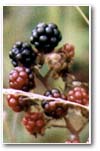
Blackberries
are an important autumn food source for a wide variety of
mammals, birds and invertebrates.
|
Mammals
A wide variety of mammals have been recorded from the Heritage Woodlands.
Not surprisingly, the best woodlands for mammals tend to be those
some distance from built-up areas.
Smaller mammals found in the woodlands include Pigmy and Common
Shrews, Field and Bank Voles and Wood Mouse, with Harvest Mouse,
Water Vole and Water Shrew having been recorded from Treeton Marsh
in Hail Mary Hill Wood.
Fox is present at many of the sites and
badgers have long lived in some. The Grey Squirrel
is the only mammal that you can be certain to spot on any visit
to any of the woods! Some of the woodlands support Hedgehog, Mole,
Stoat, Weasel, Rabbit and Brown Hare. A number of the woodlands
are feeding areas for Noctule, Leislers and, most frequently, Pipistrelle
bats.
Red Deer have been known to use Wheata
Wood and Prior Royd, these being the remnants of a herd
originally established in Wharncliffe Chase and released in the
1940s. Badger was present in a number of the woodlands until the
1960's but is now either rare or extinct in most of the woods, probably
as a result of a combination of persecution and disturbance.
  
|