WOODLAND TYPES
The wildwood which developed in the South Yorkshire region following the last Ice Age is thought to have consisted of three main types of vegetation:
- Wet woodland dominated by Willow and Alder in the valley bottoms
- Oak-Birch woodland on lower valley slopes
- Birch-Rowan scrub on more exposed sites
Although elements of each of these still remain in the Heritage
Woodlands, they have over time, been substantially altered by human
activity. Even the most 'natural' parts of the Heritage Woodlands
are now 'semi-natural' meaning that although they still partly resemble
their natural state, they have been affected to a greater or lesser
extent by human intervention. Their long history
of woodland management has led over time to significant changes
in the composition and structure of the woodlands. In particular,
the planting at the end of the 19th century of areas of non-native
trees such as Beech
and Sycamore
has had a major impact on the communities of trees found within
the woodlands.
The woodlands can be divided into a number of broad types on the basis of their species composition and other characteristics and these are described below. In these descriptions, the woodland structure has been broken up into three horizontal layers:
The Canopy - The uppermost layer, formed from the crowns of mature trees
Shrub Layer - The middle layer consisting of both low shrubs and small trees
Ground Flora - The lowest layer, consisting of woodland wildflowers, grasses and ferns
|
|
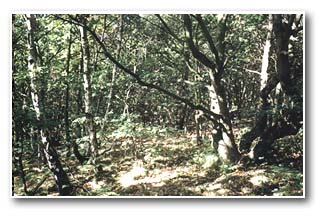
Oak and birch are common native tree species in the Heritage
Woodlands.
|
OAK AND BIRCH WOODLAND
This is the most extensive semi-natural woodland type in the Heritage Woodlands and is especially found on slopes and dry areas of flatter ground.
Canopy
As well as Oak and Birch, trees include Beech,
Sweet
Chestnut, Sycamore,
Ash,
Wild
Cherry and Wych
Elm. The main species of Oak is Sessile
Oak, which is characteristic of well-drained, acid soils on
higher ground and can be told from Pedunculate
or English Oak by its long-stalked tapering leaves and short-stalked
acorns. Pedunculate Oak occurs alongside Sessile Oak in some of
the woods where it has probably been planted.
The age of these trees varies widely and they range from short, twisted and multi-stemmed specimens to tall and well-formed standards.
Shrub Layer
Shrub species found in the Oak-Birch woodlands include Hawthorn,
Dog
Rose, Blackthorn,
Elder,
Holly
and Hazel;
the last three of these being the most frequent and widespread.
Although some areas of Oak-Birch woodland in the Heritage Woodlands have a dense shrub layer, it is more often poorly developed. The number of young trees varies considerably, depending upon the density of the canopy.
Dense Holly thickets occur in some of the woodlands, for example Prior
Royd. These are known as haggs and originated as managed
sources of winter feed for cattle.
Ground Flora
This is mainly dominated by grasses, in particular Wavy Hair-grass and Creeping Soft-grass. Where the canopy is more open or where soils are deeper, Bracken and Bramble are frequent. Bluebell can be abundant in places, along with other ancient woodland indicators such as Wood Anemone, Yellow Archangel, Dog's Mercury, Ramsons, Common Cow-wheat and Greater Stitchwort.
|
|
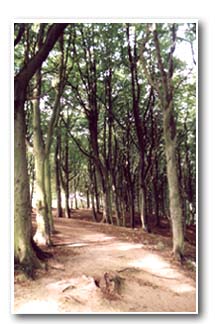
Bare ground is common under beech plantations such as this one
in Gibbing Greave.
|
PLANTATION AREAS
Significant parts of many of the Heritage Woodlands have, for the past century, been dominated by planted non-native trees, such as Beech, and to a lesser extent, Sweet Chestnut and Sycamore. In some replanted areas of the woodlands, Beech is almost the only tree species and this has led to a substantial decline in the quality and wildlife value of these previously semi-natural areas.
Canopy
As well as Beech, Sweet Chestnut and Sycamore, other trees include
Oak, Birch, Ash and Rowan. A very few areas of woodland, for example
around the 'bomb-hole' in Wheata Wood
have been planted with conifers. Many of the trees in these plantation
areas are diseased or dying.
Shrub Layer
The shrub layer is generally conspicuous by its absence, with only occasional Holly, Elder and Hawthorn. Regeneration of young trees is also minimal, although small patches of young saplings can be found in places, particularly where the collapse or felling of large old trees has let in light. These are generally of the same species as those in the canopy.
Ground Layer
As a result of the dense shade cast by the canopy, particularly under Beech, the ground often has bare soil and this has led to some soil erosion. However, some grass-dominated areas occur and Bluebells are present in small numbers, as are Wood Sage, Foxglove, Wood Anemone, Honeysuckle and Bramble. Beech-dominated areas can be rich in fungi.
Sycamore, though not native to Britain, differs from Beech and Sweet Chestnut in that it is often associated with areas of ancient woodland ground flora, possibly because both prefer deeper, richer and damper soils.
|
|
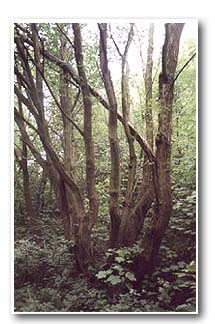
An area of mixed woodland near the stream through New Hall
Wood.
|
MIXED WOODLAND ALONG STREAMS
Streamside areas often support more semi-natural communities of trees
and plants than elsewhere. They are less likely to have been planted
and are usually damper and richer in nutrients. Other similar areas
are found downslope from springs, for example, in Hail
Mary Hill and Falconer Woods.
Canopy
There is a mixture of native trees such as Oak, Ash, Wych Elm, Wild Cherry, Rowan, Alder, English Elm, Field Maple and Willow, and non-native trees including Beech, Sycamore, Sweet Chestnut and Hybrid Black Poplar. Often, no one species is dominant.
Although elm was once an important species in this type of woodland, its population has been heavily reduced as a result of Dutch Elm Disease.
Shrub Layer
Most areas of mixed woodland have a varied structure and a diverse shrub layer. Shrub species include Elder, Hawthorn, Hazel, Willow, Holly, Dog Rose, Bramble and Guelder Rose, as well as young saplings of Oak, Beech, Ash and Sycamore.
Ground Flora
The ground flora is in these areas is often rich and can include ancient woodland indicators not found elsewhere in the woods. There is usually a good range of other herb species, including Lesser Celandine, Enchanter's Nightshade, Meadowsweet, Pignut, Angelica, Opposite -leaved Golden-saxifrage and various species of grasses, rushes, sedges and ferns.
|
|
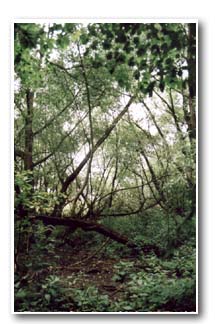
Wet woodland dominated by Willow on the Car Brook in Bowden
Housteads Wood.
|
WET WOODLAND
Areas of wet woodland dominated by Willow or Alder are found in a
number of the Heritage Woodlands. Such woodland is known as 'carr'
and at Bowden Housteads Wood this
has given its name to the Car Brook which runs through the site.
Canopy
Willows in these areas of woodland include Crack Willow, Goat Willow
and Common Sallow. Other areas, for example that in Herringthorpe
Wood, are dominated by Alder. Other trees can include small
numbers of Oak, Ash and Grey Poplar.
Shrub Layer
Elder, Hawthorn, and Hazel may form an open shrub layer in areas of wet woodland.
Ground Flora
This is generally tall and lush and contains species typical of marshy places. There can be carpets of Lesser Celandine, Creeping Buttercup and Wood Anemone, together with Meadowsweet, Brooklime, Valerian, Angelica, Great Willowherb, Nettle, Dog's Mercury, Wood Horse-tail, Opposite-leaved Golden-saxifrage, Bittersweet, Water Mint and the introduced species, Himalayan Balsam and Japanese Knotweed.
|
|
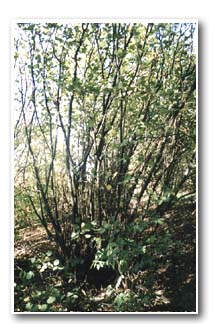
Coppiced Hazel in Cliffe Wood. This area of coppice is of
modern origin having been created accidentally by miners cutting trees
for firewood during strikes.
|
COPPICE WOODLAND
Although large areas of the Heritage Woodlands were once managed by
coppicing, evidence of this is now rare. However, one small area of
woodland in Carr Wood in the Gleadless
Valley is of particular interest, having a shrub layer of multi-stemmed
Hazel, some of which grows from coppice stools of over one metre in
diameter, underneath a canopy of Oak. There are also a few multi-stemmed
oaks growing from coppice-like stools. This area of woodland is important
as it shows what substantial areas of the Heritage Woodlands would
have been like when they were managed by coppicing.
In other woodlands, there exist coppice areas of more recent origin.
Trees under power lines in a number of the woodlands are coppiced
from time to time in order to prevent interference with the electricity
cables. In parts of some of the woodlands, in particular Cliffe
Wood, many of the trees and shrubs are multi-stemmed as a result
of the ad hoc coppicing received during various miners strikes,
when trees became used as a source of firewood.