| THE HERITAGE WOODLANDS
THROUGH HISTORY
The history
of the Heritage Woodlands reflects the gradual change from wood-pasture
to coppice management and then to plantation forestry, that is typical
of many woodlands in South Yorkshire. This history is shown in a
visual way in the interactive
part of this website.
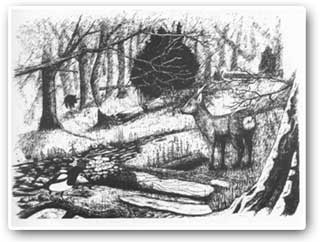
|
The prehistoric wildwood.
Reproduced with kind permission from Rotherham's Woodland
Heritage by Mel Jones and Bob Warburton (Rotherwood Press,
1995)
|
Prehistory
Many of the Heritage Woodlands date back to the end of the last Ice Age, 10,000 years ago. The wildwood vegetation which developed naturally in the area following this is thought to have consisted largely of Oak-Birch woodland, with Birch-Rowan scrub on more exposed sites, and wet woodland dominated by Willow and Alder in the valley bottoms.
 |
|
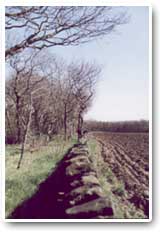
This field between Wheata Wood and Prior Royd would have at one time been covered by woodland
|
Clearance
The clearance of this wildwood began slowly with the arrival of Neolithic settlers in around 4,000B.C. It accelerated with the growth of agricultural settlements and continued apace until the time of the Norman conquest.
Even after the clearance of woodland for agriculture had slowed down, woods were still being destroyed by the removal of timber for firewood. By the 17th century however, the destruction of local woodlands had more or less ceased and it is possible that the woods were saved by the early use of coal from local pits as a substitute for firewood.
Wood Pasture
By the time of the Domesday survey of 1086, only around 15 % of South Yorkshire was still covered by woodland. At this time, much of this woodland was being managed as wood pasture, in which the woodland was exploited for its trees, as well as being used as pasture for animals. This type of management was common where woods were widespread and the population sparse and scattered. It is known to have continued in Bowden Housteads Wood until at least 1332.
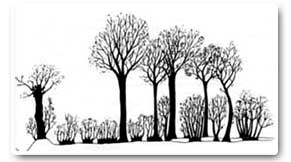 |
A diagrammatic representation of a wood managed as a coppice-with-standards.
Reproduced with permission from The Making of the South Yorkshire
Landscape by Mel Jones and Bob Warburton (Wharncliffe Books,
2000)
|
Coppicing
As populations
grew and as demand for timber increased, woods became scarce and
valuable resources that had to be fenced to prevent animals entering
them and preventing the growth of young trees. At the same time,
coppicing, a type of management which gave a continuous and
self-renewing supply of wood, was introduced. Coppicing involved
a regular cycle of harvesting of the poles that sprouted from the
base of a tree known as a coppice stool. To facilitate this, woodlands
were subdivided into compartments, each coppiced in a different
year of the cycle.
The earliest local record of coppicing dates from 1421. However, the practice would undoubtedly have been carried out on a casual basis much earlier than this. At the time of John Harrison's survey of 1637, many of the surviving woodlands in the area, were being managed by coppicing.
In order to protect the young coppice from grazing, both the external boundary of the woodland and the compartment boundaries were provided with stock-proof fences, hedges or walls, often placed on top of low banks. These features, which prohibited animals from entering and preventing regeneration, are sometimes still evident in the form of low, winding banks and ditches.
Although animals were excluded from woodlands whilst the poles were growing, it was common practice to allow livestock in once the coppice was nearly full grown. This was usually done on payment of a fee. This grazing would have taken place in clearly defined compartments where coppice regrowth was fully established and where grazing could no longer damage the trees.
Coppicing declined
following the middle of the 19th century but went on in some of
the woodlands until at least the end of the century, after which
it became uneconomic. Regrettably, there is now little physical
evidence left to show that the woodlands were once coppiced. An
exception to this are parts of Carr
Wood in the Gleadless Valley which still have large Hazel
coppice stools and multi-stemmed Oaks which may be over 200 years
old.
Woodland Products
The Heritage
Woodlands were for hundreds of years managed to produce raw materials
for agriculture, building and industry. Indeed, many of the Heritage
Woodlands may have only survived because of their value as a source
of raw materials.
Most importantly
of all, the woodlands provided raw materials and fuel for South
Yorkshire's world famous iron and steel industry. Undoubtedly
the main use of the long, thin wooden poles produced by coppicing
would have been the production of charcoal for iron smelting and
steel production. It was the coincidence of woodland and ironstone
deposits that lead to the early development of the area's early
iron industry and in the 17th and early 18th centuries the availability
of charcoal was one of the most important locational factors for
this. Professor Melvyn Jones considers that
the production of charcoal for use as a fuel in smelting iron is
the oldest recorded woodland industry in South Yorkshire, a document
produced locally in 1161 having given permission to a local community
of monks to collect enough dead wood to feed four iron furnaces.
Charcoal was produced within the woodlands by stacking cut wood in such a way that when a fire was started in the stack, the relative shortage of oxygen meant that the wood was not burned but instead carbonised to make charcoal. Places where charcoal stacks were built within the woodlands are now detectable as flat 'platforms' and in these places, fragments of charcoal can often still be found just below the surface.
Although the use of charcoal
for iron smelting declined in the 18th century with the advent of
coke, it was still being used in the steel industry into the early
20th century. There was a charcoal works at Blackburn Wheel until
1922 and some of the charcoal from this may have been used in the
iron foundries in nearby Thundercliffe Grange.
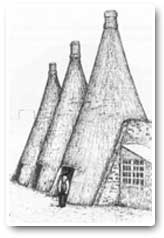 |
Cementation furnaces in Sheffield in the late 19th century. These would have used a large amount of charcoal from the Heritage Woodlands.
Reproduced with permission from Sheffield's Woodland Heritage by Mel
Jones and Bob Warburton (Green Tree Publications, 1993) |
As well as the use of coppice
poles to make charcoal, the woods are known to have been exploited
for a wide range of other products, both officially and unofficially.
Whitecoal,
a material somewhat similar to charcoal but used in lead smelting
rather than iron and steel production is also known to have been
produced within some of the Heritage Woodlands, in particular those
in the Gleadless Valley.
Timber from
large trees was sold to local sawmills. For example, timber from
Cliffe Wood is known to
have been used in the local coal mining industry, and documentary
evidence from 1877 shows that wood from Birkin
Royd was sold for the production of stakes and besom brooms.
|
Besom broom makers.
Reproduced with permission from Rotherham's Woodland Heritage by Mel
Jones and Bob Warburton (Rotherwood Press, 1995) |
Bark from Oak trees felled in the woodlands was sold for use in the
leather tanning industry until the closing decades of the 19th Century.
Some parts of the woodlands were managed as holly haggs to provide
winter fodder for cattle and Holly occurs frequently in many of the
woodlands to the present day.
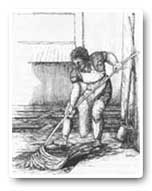 |
Oak bark from the Heritage Woodlands was sold for use in the tanning industry.
Reproduced with permission from Sheffield's Woodland Heritage by Mel
Jones and Bob Warburton (Green Tree Publications, 1993)
|
Relating just
to Woolley Wood was the
use of extremely hard Hornbeam timber to make cogs and pulleys for
machinery before steel became widely available. It may be that Hornbeams
were planted in Woolley Wood specifically in order to provide components
for the water-powered mills built around Sheffield in the 18th century.
In
addition, quarries and pits in many of the woodlands were used to
produce building stone and small quantities of coal and other minerals.
Coppice woodlands were often the target of trespassers and thieves who stole timber, wood and bark. In addition, the practice of collecting hazel nuts could cause widespread damage to wood boundaries and to coppiced areas and in the autumn of 1812 the Duke of Norfolk posted notices around woodland boundaries, including those of Canklow Wood, warning of prosecution for 'nutters'. A copy of this notice can be seen in Rotherham's Woodland Heritage.
For more information on woodland crafts and products in South Yorkshire,
visit the website of the Working Woodlands Trust www.workingwoodlands.info
 |
|
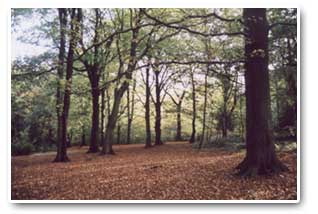
When coppicing declined in the late 19th century, non-native trees such as Beech were planted in its place.
|
High Forest
Competition from
coal for domestic fuel, and the rise of steel and iron in construction
meant that by the mid-19th century, the demand for coppice products
was in sharp decline. Income from local coppice woodlands had
fallen sharply and in the final years of the 19th century the coppice
management of local woodland became uneconomic.
As a result,
the woods became managed purely for timber, and more and more woodlands
were converted into high forest, with all trees being allowed
to grow to maturity before being felled. Coppice stools were 'singled'
to provide timber trees by selecting the best stem and allowing
only this to grow into a standard tree. The oldest coppice stools
and sickly trees were cleared away and in their place were planted
young timber trees. Some of these, for example Yew,
Wild
Cherry, Hazel,
Oak, Ash,
Elm and Birch, were native to the South Yorkshire area; but many
others, such as Sycamore,
Common
Lime, Sweet
Chestnut, Beech
and Larch,
were not.
 |
|
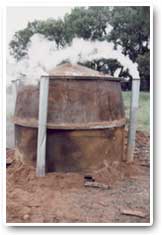
In some of the Heritage Woodlands, charcoal has been produced
on a small-scale for the first time in a hundred years using this new
design of charcoal burner.
|
Recent History
Throughout the
20th century, the replacement of woodland products with other materials
such as plastics continued and this left the woods unmanaged and
undervalued.
Although coppicing
had largely disappeared by the early 20th Century, some small-scale
coppicing and removal of young trees did take place in the 1940's
in a number of the woodlands to provide the wood required during
the Second World War. A more modern example of coppicing is found
in parts of some woodlands such as Cliffe
Wood. Here trees, which were cut for firewood on an ad
hoc basis during the miners' strikes of the early 1980's, are
now sprouting coppice poles.
Having been
in private ownership for many years, the 35 Heritage Woodlands were
either given to or purchased by their current owners, the Local
Authorities. This occurred throughout the twentieth century. Bowden
Housteads Wood for example, came into the ownership of Sheffield
City Council as early as 1916, whilst Canklow
Wood was purchased by Rotherham Metropolitan Borough Council
as late as April 2000, using money provided by the Heritage
Lottery Fund for the Fuelling a Revolution programme.
Further Information
Further information on the history, both of the Heritage Woodlands and of other woodlands in South Yorkshire, can be found in Professor Melvyn Jones' excellent books, Sheffield's Woodland Heritage and Rotherham's Woodland Heritage.
  
|