 |  |  |  |  |  |  |  |  |


| ||||||||||
| | |||||||||
BOWDEN HOUSTEADS
WOOD To
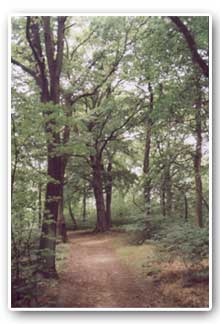
download a map and trail leaflet click here. The wood is first recorded in an inventory of property compiled in 1332 following the death of Thomas de Furnival, Lord of Hallam. It is also referred to in a document written in around 1600, which lists it as a coppice woodland belonging to the 7th Earl of Shrewsbury. These two pieces of documentary evidence clearly show that Bowden Housteads Wood is an ancient woodland, in other words, one that has been in existence for at least the last 400 years.
The majority of the wood is dominated by Oak and Beech, together with Sweet Chestnut and Sycamore. Under these areas is found a variety of wild flowers characteristic of ancient woodlands, for example Bluebell, Wood Anemone, Yellow Archangel and Lesser Celandine, all of which are abundant in places. The woodland is crossed by a number of small streams with which are associated areas with a greater variety of tree species than elsewhere in the wood as well as a relatively rich ground flora. The wettest areas are to be found along Car Brook in the northern section of the wood. Here the woodland is dominated by Crack Willow and there is a rich variety of herb species. At its south-western corner, Bowden Housteads Wood merges into the unimproved grassland, heathland, wetland, scrub and willow of Car Brook Ravine and Spring Wood. This area is a nature reserve managed by the Sheffield Wildlife Trust. The variety of habitats
within and around the edges of the site supports a number of interesting
and unusual invertebrates. Birds and mammals recorded in the area include
a number that are relatively uncommon or declining in numbers. Other nearby Heritage Woodlands are:
|