|
HERDINGS
WOOD - EDUCATIONAL USE
INTRODUCTION
Being situated only two
miles from Sheffield city centre and in an area with a large population
and a number of schools, the woodlands of the Gleadless Valley are
ideally placed to be a valuable environmental education resource
for both primary and secondary pupils.
Although smaller
than some of the other woodlands in the Gleadless Valley, Herdings
Wood has considerable potential as a site for educational use. More
detailed information to support education work in the wood can be
found in the Fuelling a Revolution education pack covering the Gleadless
Valley's woodlands and open spaces. Details on how to obtain this
can be found in the Schools
section of this website.
SUGGESTED
ACTIVITIES FROM THE SCHOOLS SECTION OF THIS WEBSITE
The Schools section of this
website provides units of work covering a wide range of subject
areas and Key Stages. Although, all or most of these units, would
be suitable for use in Herdings Wood, some are particularly appropriate,
and for this reason, direct links to these downloadable materials
are provided below.
Key Stage 1
Numeracy - 'Looking
at Leaves'
The variety of tree species in Herdings Wood makes
it particularly suitable for this unit with its focus on leaf shape
and symmetry. Most of the leaves shown on the pupil sheet are present
in the valley's woodlands.
Key Stage 1
Science - 'Plants
& Animals'
The proximity of Herdings Wood to areas of open ground at Herdings
Meadows and Nether Spring Open Space makes it ideal for this unit
comparing the flora and fauna of wooded and non-wooded areas.
Key Stage
1 Geography - 'Our
Local Wood'
The proximity of the Gleadless Valley's woodlands to local schools
makes them particularly suitable for this unit which incorporates
the wood into a walk around the locality of the school looking at
different land uses.
Key Stage
2 Science - 'What
Lives Where?'
The range of vegetation types in and adjacent to the woodlands of
the Gleadless Valley provides an excellent resource for studying
where specified animal species might find shelter, water and food.
Key Stage 2 Science -'Life
Cycles'
The woodlands of the Gleadless Valley clearly demonstrate a range
of tree life-stages, from germinating seeds to over-mature trees.
Key
Stage 2 Geography- 'Pictures
and Plans'
Because of its relatively recent development, the Gleadless Valley
offers much potential for examining changes to an area over time.
Access to an archive of old photographs of the area can be made
available by contacting the Gleadless Valley Wildlife Group.
Key Stage 2
Geography - 'Do
you come here often?'
Because of their urban setting, the woodlands, meadows and parks
of the Gleadless Valley are extensively used for recreation (e.g.
walking, motorcycling, dog walking and wildlife study) and so are
particularly good for studying recreational use of urban open spaces.
The effect of the woodlands and other open spaces on the character
of the local area could be considered.
Key Stage 3
Science - 'Are
all woods the same?'
A wide variety of contrasting areas are available for comparison
in Herdings Wood and its adjacent open areas. These include:
- dry areas
and streamsides
- the edges
and interior of the woodlands
- woodland
and adjacent open space
Key Stage 3
Geography - 'Woodland
Climates'
Use this unit to compare the climates of the woodlands and their
adjacent open spaces. The woodlands and other greenspaces of the
Gleadless Valley range widely in altitude, aspect and proximity
to streams and this could be a further focus of investigation.
Key Stage
3 Geography -'Woodlands
in the World'
The extent to
which the woodlands and other open spaces of the Gleadless Valley
are under pressure from the large surrounding urban population could
form a focus for study. The effect on the sites of undesirable uses
such as tipping, motorbike riding, vandalism and the dumping of
stolen cars could be considered as could the varying pressures on
different woods and open spaces in the valley.
 |
|
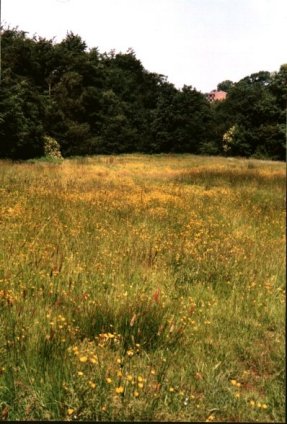
As well
as its seven Heritage Woodlands, the Gleadless Valley also
contains some excellent wildflower meadows, the wildlife of
which can be compared to that of the woodlands.
|
OTHER
ACTIVITIES
Key Stage 2
& 3 Geography
The number of streams running through the Gleadless Valley's woodlands
make it a good location for stream studies.
Follow a stream from its
source, through its confluence with other streams, to its confluence
with the Meers Brook and the culverting of this below the old Blackstock
tip. Measure the changing width, depth and speed of flow (by floating
oranges) of the stream along its course and compare the varying
composition of the stream beds, which include exposed bedrock (sometimes
causing cascades), stones, silt and mud. Examine the form of the
stream valleys which vary from steep sided (for example in The Lumb)
to more open cross sections further downstream.
The wildlife
of the streams and ponds could also be investigated. The streams
contain a range of freshwater animal species, including fresh water
shrimps and immature caddis fly, stonefly and mayfly.
When
undertaking stream work, appropriate caution should be exercised,
particularly after wet weather when the streams can be relatively
deep and fast flowing. Consideration should also be given to the
intermittent pollution of some of the streams. As they have their
source on the relatively protected area of Leeshall golf course,
the streams in the upper parts of Leeshall Wood are the least polluted.
The short length of the Meers Brook below Carr Wood, having passed
under the old Blackstock Tip, is particularly polluted and should
be avoided.
In addition,
other useful resources from 'get,
set … Grow', the South Yorkshire Forest schools' pack,
can be downloaded from Downloadable Pupil and Teacher Resources
for Key Stage 2 in the Schools
section of this site.
The 'Tree File'
CD ROM that accompanies the 'get, set … Grow' pack contains
identification details and background information for all of the
major tree and shrub species found in the wood including Birch,
Elder, Hazel and Oak. For further information, go to the section
on printed education materials in the Schools section of this website.
  
|