

The ProgrammeThe WoodlandsLocation MapEventsNewsSchoolsChildrenInteractiveFeedback
The ProgrammeFuelling a Revolution
More information - Herdings Wood
  visiting the wood
  landforms, rocks and soils
  history and heritage
» plants and trees
  vegetation
  birds and animals
  educational use
  woodland restoration and
   management work
HERDINGS WOOD - PLANTS AND TREES

TREES
Like t
he other woodlands of the Gleadless Valley, Herdings Wood contains a mixture of native and non-native trees.

On drier soils, Oak is the most widespread native tree. Ash can be frequent in damper areas of woodland, particularly in valley bottoms and on stream banks. Alder is present in the wettest parts of the woodland.

Although non-native trees are present in Herdings Wood, there are no big blocks of planted non-native trees. The most frequent non-native trees in the wood is Sycamore and smaller quantities of Larch and Hybrid Poplar are also present.

SHRUBS
Shrubs in Herdings Wood include Holly, Hazel, Guelder Rose and Hawthorn. Because there are no major areas of planted trees in the wood, the shrub layer is relatively well developed in comparison to that in some other woodlands in the valley.

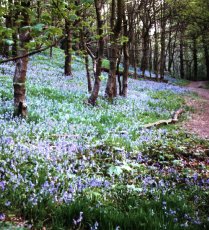
Bluebells are a common and attractive feature of the Gleadless Valley's Heritage Woodlands.

WOODLAND GROUND FLORA
In comparison to the other Gleadless Valley woodlands, Herdings Wood has a relatively rich flora for its small size. This is due both to the less acid soils and to the absence of big blocks of planted non-native trees, which tend to reduce the diversity of the ground flora.

Seventeen ancient woodland indicator species can be found in the wood, including Wood Anemone, Yellow Archangel, Yellow Pimpernel, Wood Sorrel, Wood Melick and Wood Millet. Apart from these, the ground flora is dominated by grasses, together with abundant Bluebell, varying amounts of Bramble, and scattered patches of flowering herbs and other grasses.

Some wet, nutrient-rich areas (known as flushes) occur along the stream banks and close to the southern edge of the eastern woodland block. Species present in these places are those associated with wet, shaded conditions, for example Lesser Celandine, Remote Sedge, Lady Fern and Wood Horsetail.


MORE INFORMATION

More general information on the plants and trees of the Heritage Woodlands can be found elsewhere on this website.

backBack to Topback