 |  |  |  |  |  |  |  |  |


| ||||||||||
| | |||||||||
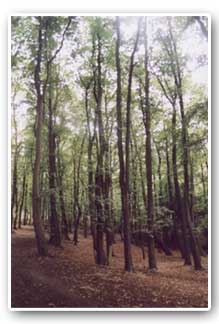
GIBBING GREAVE AND HERRINGTHORPE WOOD Gibbing Greave is known from both documentary and other evidence to be an ancient woodland, that is, a woodland that is more than 400 years old. Herringthorpe Wood is also thought to be of ancient origin although the evidence for this is less clear. About a century ago, large parts of both woodlands were greatly modified by the planting of substantial areas of Beech and to a lesser extent of Sweet Chestnut. There are however significant areas of semi-natural woodland including Oak-dominated woodland in Gibbing Greave and an area of wet Alder woodland in Herringthorpe Wood. Despite this planting, which has had the effect of reducing the numbers of species of plants and animals found in the woodlands, the site still supports a wide range of wildlife including sixteen ancient woodland plant indicators and a wide range of birds, including Sparrowhawk, Tawny Owl and Great-spotted Woodpecker.
The two woodlands are popular places for formal and informal recreation and, as well as being prominent features of the local landscape, they form a gateway from the edge of Rotherham to the open countryside. The area has for some time been the focus for an environmental arts initiative. Under the Fuelling a Revolution programme, woodland restoration and access improvement work is taking place to restore the two woodlands to their former glory and to maximise their potential as a recreational and educational resource. Particularly in plantation areas, measures will be taken to extend the life-span of the better formed trees and to encourage the growth of replacements and the recovery of the ground flora and shrub layers. Some thinning and small group felling will be carried out, with Sycamore, a non-native and highly invasive species, being particularly favoured for removal. Access to the woods will be improved by upgrading the path system, with a particular focus of this being, where practical, to provide access for less able-bodied people. Finally, the potential of the site as an educational and environmental arts resource is being further developed through guided walks, events relating to the natural history and historic interest of the site, children's events and practical management tasks.
|