

The ProgrammeThe WoodlandsLocation MapEventsNewsSchoolsChildrenInteractiveFeedback
The ProgrammeFuelling a Revolution
More information - Carr, Ashes & Coneygree Woods
  visiting the wood
» landforms, rocks and soils
  history and heritage
  plants and trees
  vegetation
  birds and animals
  educational use
  woodland restoration and
   management work
CARR, ASHES & CONEYGREE WOODS - THE SITE

GEOLOGY
The rocks underlying the woodlands of the Gleadless Valley belong to the Coal Measures and were formed between 325 and 280 million years ago, during the Carboniferous period of geological time.

The rocks consist of alternating bands of shale and sandstone, the relative proportions of which vary. Ashes and Coneygree Woods, the higher of the three woodlands, are underlain largely by sandstone, whilst Carr Wood is underlain mainly by shales.

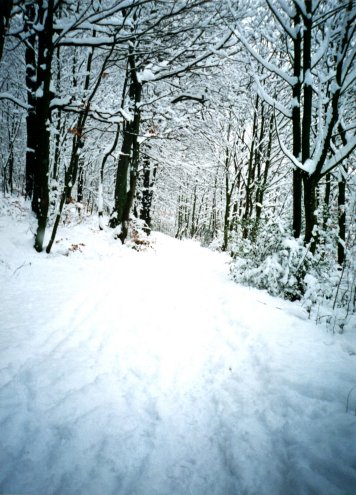
Snow adds a magical new dimension to the woodlands of the Gleadless Valley.

LANDSCAPE
Carr Wood is the lowest lying woodland in the Gleadless Valley, its northern end lying at just over 90 metres above sea level.

All three woodlands are situated in narrow valleys belonging to tributaries of the Meers Brook. Many of these originate either in the woods or in the green spaces surrounding these. The sources of the streams are either artificial culverts or natural springs. Although most of the latter occur on the valley sides, some can also be found in the valley bottoms, particularly where sandstones and shales meet.

The streams are generally shallow. They range from 0.5 to 3 metres in width and mainly have stony beds, with occasional silt and mud patches. The amount of water in the streams varies considerably from season to season. In dry periods, smaller streams disappear, and even the wide lower stretch of the stream through Carr Wood can sink beneath its stony bed.

Towards the northern end of Carr Wood, the tributary streams join the Meers Brook, the main watercourse through the Gleadless Valley. Immediately prior to reaching Carr Wood, this has been culverted beneath the landfill area of Blackstock Open Space. The river emerges again for a short distance and exhibits meanders, patches of mud and silt, and deep pools, before entering another culvert for the remainder of its journey to join the River Sheaf.


SOILS
Three main soil types underlie the woodlands of the Gleadless Valley: acidic soils, neutral soils and waterlogged soils. Ashes and Coneygree Woods, the two higher woodlands, are mainly underlain by dry, acidic soils over sandstone. Carr Wood on the other hand is underlain by shales and has more neutral, deeper and wetter soils.

Thin dry 'acidic soils' occur over sandstone, particularly on higher ground, as well as over shales on steep slopes. The depth and acidity of the soils is strongly affected by slope, with the thinnest and most acid soils being found on steeply sloping sites. Deeper and less acidic soils occur on flatter ground, even over sandstone.

Neutral soils are mainly found on flat to moderately sloping ground over shales. They vary in depth and clay content and also from dry to seasonally wet, the wettest areas being on stream banks, in valley bottoms and by springs and wet nutrient rich areas known as flushes.

Waterlogged soils are found in association with streams, springs and flushes. They occur mainly over shale, particularly where this meets sandstone strata. These conditions occur on the valley slopes as well as in the valley bottoms and by streams. Some of the springs are wet all year round but the flushes are more seasonal.

VIEWPOINTS

Being largely situated in valley bottoms, Carr, Ashes and Coneygree Woods have only a limited number of viewpoints over the surrounding area. The best view of the woodlands themselves can be gained from the access road to Newfield School, at the southern end of Ashes Wood.

backBack to Topback