|
CARR,
ASHES & CONEYGREE WOODS - ANIMALS
In
addition to their plants, the three woodlands support a wide range
of birds, mammals and invertebrates.
INVERTEBRATES
In spring, butterflies
such as the Orange-tip, Green- veined White, Comma, Small Tortoiseshell
and Peacock, can be found in both the woodlands and open habitats
of the Gleadless Valley. Later in the summer, butterflies generally
become less evident in the woodlands themselves, being instead more
restricted to open habitats and woodland glades. An exception to
this is the Speckled Wood butterfly, which can occasionally be seen
in areas of dappled sunlight in the woods and shrub areas.
Invertebrates
in the Meers Brook and its tributary streams include fresh water
shrimps and the young stages of caddis fly, stonefly and mayfly.
Ponds support a number of dragonfly and damselfly species, along
with a wide range of other aquatic invertebrates.
 |
|
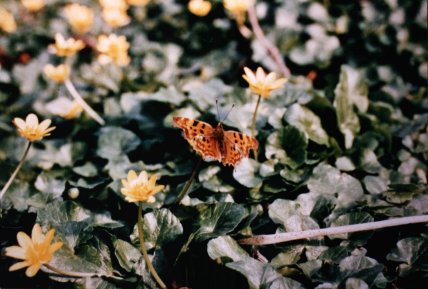
A Comma
butterfly on Lesser Celandine, a common flower in the Gleadless
Valley woodlands.
|
AMPHIBIANS
Common Frog,
Toad and Newt all breed in Lees Hall pond, close to the eastern
edge of Coneygree Wood.
BIRDS
The Gleadless Valley's
wide range of habitats attracts a rich bird fauna for an urban area.
The richest areas for birds are the woodlands and areas of mixed
shrub and grassland habitat such as that found at Lees Hall Open
Space on the eastern edge of Carr and Coneygree Woods.
Birds breeding
in the woodlands include Great-spotted Woodpecker, Sparrowhawk,
Jay, Tawny Owl, Long-tailed Tit, Treecreeper and Nuthatch. Summer
songbird visitors, including Blackcap, Chiffchaff, Willow Warbler,
Lesser Whitethroat and Garden Warbler, breed in woodland areas with
a dense shrub layer, at woodland edges and in shrub thickets.
Other bird species
recorded in the valley have included Cuckoo, Green Woodpecker, Lesser-spotted
Woodpecker, Woodcock, Snipe, Redstart, Willow Tit and Grasshopper
Warbler. In addition, the valley's streams attract the Grey Wagtail.
MAMMALS
Squirrels, Bats, Stoats, Weasels and Foxes live within the
woods and other greenspaces in the Gleadless Valley. Badger was
present in the 1960's but is now either very rare or extinct, probably
as a result of a combination of persecution and disturbance.
MORE
INFORMATION
More general information on the birds
and animals of the Heritage Woodlands is available elsewhere
on this website.
  
|