|
CANKLOW WOOD -
THE SITE
GEOLOGY
Coal Measures rocks, formed
during the Carboniferous period of geological history, underlay the area.
Under the majority of the site, these consist of relatively soft mudstones
and shales. Along the eastern and south-western edges of the site, these
softer rocks are replaced
by sandstones. On the upper part of the site these have been extensively
quarried to provide the building stone known as Rotherham or Mexborough
Red Rock, which can
be seen in use in a number of Rotherham's buildings, including the Parish
Church.
Where exposed in quarry
faces, these sandstones often show 'cross-bedding' which
results from
the way in which the rocks were deposited in layers on the edge of a shallow
sea.
LANDSCAPE
Canklow Wood is situated on a west-facing hillside overlooking the valley
of the River Rother. This position makes the site a very prominent feature
in the landscape, which dominates southern and western approaches to Rotherham,
particularly from the M1 and the Sheffield Parkway.
SOILS
The soils at Canklow Wood are generally acid, particular over the sandstones
where there has been some intense leaching of nutrients. In other areas,
there are deeper brown earths with somewhat less acid organic matter.
VIEWPOINTS
 |
|
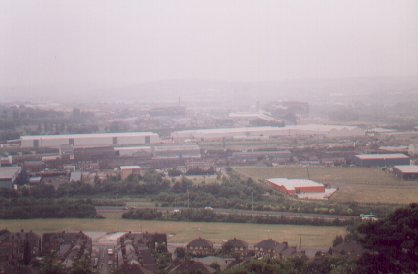
The view westwards from Boston Castle showing the Magna Centre
and
the steelworks
of the Rother Valley.
|
Upper parts of the site offer
extensive views across the Don Valley and Sheffield. The best viewpoints
are from the top north-east corner of the site and particularly from Boston
Castle in the adjoining area of Boston Castle Park where there is a plaque
showing the direction of a variety of places of interest.
Features that can
be seen from here include the steelworks below Canklow and in the Don
Valley. The Magna Centre can be seen in front of Tinsley Viaduct with
its two adjacent disused cooling towers in front and Meadowhall behind.
To the north (right) can be seen the follies of Keppel's Column and Hoober
Stand, both associated with the Wentworth Woodhouse estate.
It is worthwhile trying
to imagine the view from this point before the start of the Industrial
Revolution, with the high moorland of the Peak District visible beyond
the rolling countryside of the Lower Don Valley.
  
|