|
CANKLOW
WOOD - MANAGEMENT
INTRODUCTION
Management work
at Canklow Wood is undertaken by or on behalf of Rotherham Metropolitan
Borough Council who own the site.
TREES AND WOODLANDS
Because of the relatively
low number of mature trees on the site, management of the mature
Oak woodland at the southern tip of the site will be restricted
to safety-related work along with some light thinning of dense younger
trees and small scale group-felling. The latter will create small
glades which encourage natural regeneration of trees, a more
varied woodland structure, and a diverse ground flora.
 |
|
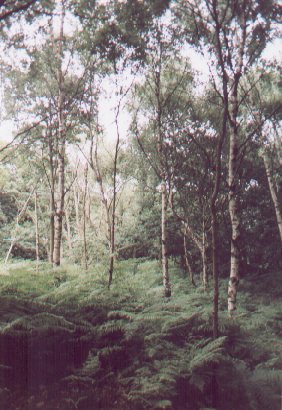
Young
'pole-stage' Birches in an area formerly occupied by acid
grassland and Bracken
|
The dense young
Birch and Oak trees which mainly occupy the upper slopes of the
site will be thinned in order to allow selected trees room to develop;
to encourage a more diverse woodland structure; and increase the
frequency of native tree and shrub species such as Oak, Rowan, Wild
Cherry, Hazel and Holly. A second possibility for these areas of
developing woodland is the reintroduction of coppicing on a 12 to
25 year cycle. This would provide a network of temporary open spaces
within the woodland and increase the amount of dense shrub habitat
which is important for a number of relatively rare or unusual birds
and invertebrates found on the site.
Wet woodland
areas, such as those on parts of the lower slopes of the site, are
a relatively scarce habitat type. Management of these areas will
be minimal, with intervention restricted to the removal of occasional
Sycamore.
In all wooded
areas of the site, annual tree inspections will be carried out and
any hazardous trees close to paths will be made safe. Where possible,
standing and lying deadwood will be left on the site to provide
a habitat for wildlife.
NON-WOODED AREAS
The mosaic of open habitats
such as acid grassland, heath, scrub and wet flushes is an important
feature of the site and is of value for wildlife. These areas will
be maintained, and where enhanced, possibly by the introduction
of appropriate grazing regimes.
Some open areas
will be encouraged to develop trees and so revert to woodland. In
order to achieve this, some control of Bracken, which is currently
competing with tree regeneration,
will be required.
BIODIVERSITY
Work is required to update the natural history records for the site,
including surveys of the plants, birds, invertebrates and bats.
Any scarce and declining species identified will be protected and
as far as possible encouraged through appropriate management.
HISTORY AND HERITAGE
The nationally important archaeological features on the site will
be protected and further work will be undertaken to survey the site
for archaeological features.
ACCESS AND RECREATION
Measures will be taken
both to encourage legitimate access to the site and to discourage
inappropriate use. Footpaths and horse routes will be rationalised
and improved, and access for people with disabilities enhanced.
The site boundary
will be secured through the restoration of neglected walls and hedges
and the erection of new fencing. This will reduce the problems caused
by the riding of motorbikes and the dumping of cars. In addition,
the tipping of garden refuse and other materials and litter will
be removed and controlled.
A range of educational
and interpretative events is being run during the five years of
the Fuelling a Revolution programme. As part of this, community
involvement in the care and management of the site will be encouraged.
More general information on the management
of the woodlands and other habitats and on access
improvements is given elsewhere on this website.
  
|