|
CANKLOW WOOD -
PLANTS AND TREES
INTRODUCTION
Although the acidity of the soil at Canklow Wood means
that the diversity of flowering plants is relatively low, a total of 164
plant species have been recorded from the area in the last 20 to 30 years.
This list, which includes mosses, grasses and trees and shrubs as well
as flowering plants, includes 40 species which are rare or uncommon in
Rotherham and in some cases elsewhere.
TREES
Those parts of the site that
are heavily wooded are dominated by two tree species, Sessile Oak and
Birch. The former is dominant near to the southern tip of the site
where the trees are significantly older than elsewhere.
|
|
|
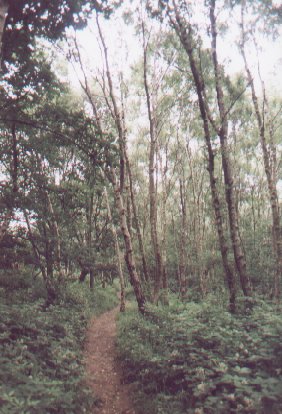
Oak and Birch
are by far the commonest trees on the site. In this picture, the
area to the left of the path is dominated by Oak whilst that to
the right is dominated by Birch.
|
Birch is the major
tree species in the younger areas of woodland which have developed following
extensive felling during the first part of the twentieth century. In parts
of these areas, for example in the top north-eastern corner of the site,
Birch and Oak
are joined by Sweet Chestnut. Birch and smaller quantities of Oak are
continuing to spread into formerly open areas, many of which were grazed
until recently.
Towards the edge of
the site, Oak and Birch are joined by other trees
including Beech, Wild Cherry and small amounts of Sycamore. In wet,
nutrient-rich areas near to the western edge of the site, can be found
Willow
and Aspen, the latter being a relatively rare tree in this part of South
Yorkshire.
Information from valuations
in 1853 indicates that the woodland species composition was similar to
that of the present day, with Oak and Birch being
the dominant species. However, the ratio of Oak to Birch was significantly
higher than it is now.
SHRUBS
Under the Oak canopy in the southern part of the site can be found a very
limited shrub layer of scattered Hazel and occasional Holly. The latter
dominates the limited shrub layer found in areas of young Birch-dominated
woodland where it is joined by occasional Elder and Hawthorn. Bramble
also occurs in some areas, particularly in association with areas of deeper
soil.
WOODLAND GROUND
FLORA
The ground flora in the woodland
areas is dominated by grasses, mainly Wavy Hair-grass and Creeping Soft-grass.
Bracken also occurs, particularly in areas
of deeper soil.
Twelve plant species
that are characteristic of ancient woodland have been recorded at the
site, including Slender St John's-wort, Wood Anemone, Dog's Mercury, Yellow
Archangel, Guelder Rose, Greater Stitchwort and Bluebell. The last of
these only becomes frequent in the mature Oak woodland in the south-east
corner of the site.
NON-WOODLAND HABITATS
Although Canklow Wood is the
second largest ancient woodland in Rotherham, its more recent history
has meant that significant areas of the site are not now wooded. These
parts of the site include substantial areas of acid grassland, as well
as smaller areas of heath, scrub and wet nutrient-rich ground known as
flushes.
Acid grassland areas
are dominated by Wavy-hair Grass, Sheep's Fescue and Creeping Soft-grass,
together with other acid loving species such as Mat Grass, Bent Grasses
and Heath Bedstraw. Associated with this acid grassland are large areas
of Bracken and occasional patches of Heather. An acid grassland ground
flora also occurs in association with old quarries where it is joined
by Bracken, Male Fern, patches of Heather and Rosebay Willow-herb.
On the lower slopes
on parts of the western edge of the site, the ground is comparatively
wet, probably as a result of underground springs, and here can be found
a ground flora of Tufted-hair Grass, Soft Rush, Cotton Grass and mosses
typical of wet places, such as Sphagnum.
OTHER PLANTS
The relatively low number of flowering plant species recorded at Canklow
Wood is compensated for by an exceedingly wide range of fungi. The number
of larger fungi recorded at the site in the last twenty years totals over
130 species, of which over 50 are rare or uncommon in Rotherham. Many
of these species were recorded within the mature Oak woodland in the south-east
corner of the site.
More general information on the plants
and trees of the Heritage Woodlands can be found elsewhere on this
website.
  
|