|
LEES
HALL WOOD - MANAGEMENT
INTRODUCTION
Under the Fuelling
a Revolution programme, woodland restoration and access improvement
work is taking place to restore this and the other woodlands in
the Gleadless Valley to their former glory and to maximise their
potential as a recreational and educational resource.
Management work
in the woodlands and other green spaces is undertaken by or on behalf
of their owners, Sheffield City Council who work in close partnership
with others with an interest in the area, in particular the Gleadless
Valley Wildlife Trust.
More general
information on the management of the woodlands
and other habitats
and on access improvements
is given elsewhere on this website.
 |
|
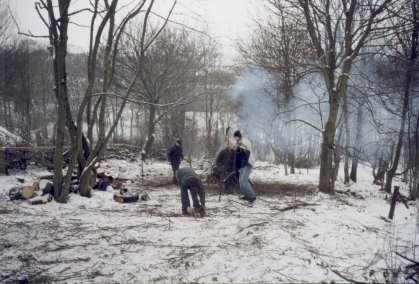
Most woodland
management work is best carried out during the winter when
trees and other plants are not growing.
|
TREES
AND WOODLANDS
As part of the Fuelling
a Revolution programme, semi-natural parts of the Gleadless Valley
woodlands are being protected and enhanced to ensure that they continue
to be species rich habitats with a diverse structure. Particular
attention is being paid to 'stream corridors', strips of land up
to 30 metres on either side of streams.
Plantations
and mixed areas within the woodlands are being managed to encourage
their development into healthy and diverse woodland areas. The long
term aim for these areas is for at least 60% of their trees to be
of native species such as Oak. To achieve this, the spread of Beech
and Sycamore saplings is being controlled, selected areas of non-native
trees are being felled, and natural regeneration of native tree
species is being encouraged, along with the recovery of currently
impoverished areas of ground flora.
Some
thinning and group felling is being carried out in Lees Hall Wood
in order to create a more varied woodland structure and to encourage
the regeneration of native trees such as Oak, Ash and Hazel. Sycamore,
a non-native and highly invasive species, will be particularly favoured
for removal.
In the course
of all this woodland management work, over-mature trees and standing
dead timber will be retained whenever possible. This will help to
maintain the presence of all stages in the life cycle of trees,
including over-mature trees, standing dead timber and fallen wood,
all of which form important habitats for a wide variety of insects,
birds and animals.
To further increase
habitat diversity, some existing and new open areas will be maintained
as permanent glades and rides. In these areas and on woodland edges,
a variety of habitat types will be encouraged and maintained, for
example by the use of coppicing.
Where possible,
income will be created from the sale of produce from woodland management
operations. However, this will always be secondary to the interests
of wildlife, archaeology, access and recreation.
BIODIVERSITY
The woodlands
and open spaces of the Gleadless Valley are home to a wide variety
of plants and animals, including a number that are relatively scarce
or with declining populations. Because of both this and the areas's
heritage and recreational value, a large part of the area is being
designated as a Local Nature Reserve, management of which will seek
to protect and encourage its scarce species and habitats and encourage
a rich diversity of plants and animals. Surveys will be undertaken
to monitor both the habitats and populations of selected plant and
animal species and to check that management objectives are being
achieved.
In
Lees Hall Wood, Himalayan Balsam, a non-native and highly invasive
species particularly associated with streamsides, is being controlled
to reduce its impact on other flora and fauna.
HISTORY
AND HERITAGE
Recent
surveys, including one carried out under the Fuelling a Revolution
programme, have found a wide range of archaeological features in
the seven Heritage Woodlands and other areas of 'relic' landscape.
These archaeological
features will now be protected, maintained and, where appropriate,
renovated and improved.
ACCESS AND
RECREATION
Lying close to large areas
of population, the woodlands and other green spaces of the Gleadless
Valley have a vital recreational role. An important part of their
management is to promote their sustainable use for recreation and
leisure, particularly by the local community.
Access to Lees
Hall Wood is being improved by upgrading the
path system, with particular focus of this being to provide access
for less able-bodied people. Work
is also required to prevent access by motorcyclists and to reduce
problems of fly tipping and vandalism.
The local community
will continue to be consulted about the management of the woodlands
and other green spaces as well as being actively encouraged to play
a practical part in this. As part of the Fuelling a Revolution and
Local Nature Reserve programmes, events relating to the wildlife
and heritage interest and leisure uses of the sites are being held
and educational use of the woodlands and open spaces is being continued
and promoted.
More general information on the management
of the woodlands and other habitats and on access
improvements is given elsewhere on this website.
  
|