WOODLAND RESTORATION
|
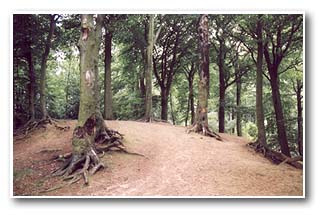
Bare
ground can be common in the heavy shade cast
by Beech plantations.
|
Why the Heritage Woods
require management
Like all other woodlands and indeed nearly all other supposedly
‘wild’ places around Britain, South Yorkshire’s Heritage Woodlands
are not purely natural features. Instead, they are semi-natural,
meaning that although they still partly resemble their natural state,
they have been affected to a greater or lesser extent by human intervention,
often for the purpose of obtaining raw materials for building, agriculture
and industry. Although in some cases, this intervention led to a
decline in the value of the woodlands as a home for wildlife, it
just as often had the effect of enhancing this. In addition, this
long history of management has also left many interesting features
testifying to the fascinating relationship between the woodlands
and man.
Having been actively managed for hundreds of years, the Heritage
Woods started to become neglected towards the end of the 19th century,
as woodland products were replaced by other materials. The lack
of management since this time resulted in a decline in the historical
character, landscape and nature conservation value of the woodlands.
Having been allowed to decline, the woods were sold or given, to
their new owners, the Local Authorities who, up to the start of
the ‘Fuelling a Revolution’ programme, lacked the resources needed
to carry out major restoration work. Areas of the woodlands replanted
in the late 19th and early 20th centuries are in particular need
of restoration, having been left unmanaged for many decades. Woodland
management work under the programme seeks to restore the landscape
and wildlife value of the woodlands and to restore or enhance their
ancient semi-natural character. This is mainly done by broadening
the range of age and size of the trees and by shifting the balance
away from non-native trees such as Sycamore, to locally native trees
such as Oak and Ash. The effect of this is to diversify the woodland
structure, creating openings in the woodland canopy, allowing light
to penetrate and thereby allowing the shrub layer and ground flora
to flourish. Work of this kind also has the effect of extending
the lifespan of and improving the quality of the better formed existing
trees and making room for their natural regeneration.
|
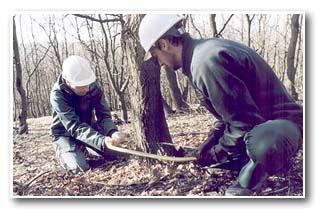
The
felling of carefully selected trees is a vital
tool in the restoration of neglected woodlands.
|
Planning woodland management
work
Management work in the 35
Heritage Woodlands is undertaken by or on behalf of their owners,
the three Local Authorities. Management
of the woodlands is guided by management plans, documents
which describe the area and which set out aims and objectives for
its management and the means by which these will be achieved. Many
of the ‘Heritage Woodlands’ already had management plans in place
at the start of the ‘Fuelling a Revolution’ programme. Where this
was not the case, management plans have been, or are now being,
produced to guide the development of the woodlands. All of these
plans are being drawn up following consultation with local communities.
This goes at least some way to reducing the distress and concern
caused to local people when the apparent 'damage' caused by the
thinning and extraction of trees takes place, and helps to provide
reassurance that the recovery of the woodland following this is
rapid. Planning of woodland management needs to allow for the fact
that much of this work can only take place during the winter months
so as to avoid damage to the trees themselves, the ground flora
and to minimize disturbance to birds and other wildlife.
|
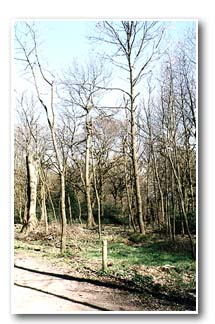
An area of Wheata Wood in which tree
thinning has recently
taken place.
|
What woodland management work is taking place?
Although management work is required at all 35 of the woodlands in the ‘Fuelling a Revolution’ programme, the exact nature of the work varies from site to site. Typical examples of the kinds of woodland work taking place are described below.
- Thinning involves the felling of individual, carefully selected trees, particularly those such as Sycamore, Sweet Chestnut and Beech, which are not native to the local area.
- Group Felling involves removing groups of trees in order to open up glades. Areas that have already been managed in this way can be clearly identified by their dense groups of young trees.
- Pruning involves removing large branches from selected trees. This might be done for safety reasons, because there is a danger of trees interfering with power lines, or because the branches shade areas of ground flora or growing trees.
- Coppicing is an ancient woodland management technique that involves the removal of tree growth just above ground level at regular intervals of approximately 10 to 15 years. Although once a widespread practice in the Heritage Woodlands, coppiced areas have now largely disappeared and this form of management will be reintroduced only in areas where the present woodland structure and the presence of typically coppiced shrubs such as Hazel make this worthwhile. Coppicing creates a network of temporary open spaces within the woodlands, thereby letting in light and increasing the amount of dense shrub habitat, which is important for a number of birds and animals.
- Restocking of the Heritage Woodlands in most cases involves allowing natural regeneration of trees to occur, once thinning and group-felling work has taken place. This is the preferred way in which to restore the natural character and species composition of the woodlands and is possible mainly because the amount of grazing in most of the woodlands is very limited. In some parts of the woodlands however, a limited amount of tree and shrub planting may be required, especially for those species which are not regenerating well naturally. When restocking, native tree species typical of ancient semi-natural woodlands, such as Sessile Oak, Birch, Ash, Wild Cherry, Alder and Hazel, are favoured. Berry-bearing trees and shrubs, such as Rowan, Hawthorn, Holly and Elder are also encouraged in order to provide a food source for birds.
- Deadwood is important because of its value as a habitat for fungi, invertebrates, hole nesting birds and bats. During woodland management operations, some dead trees or parts of trees are left as standing deadwood, with other dead wood being left on the woodland floor as fallen deadwood. In some of the woodlands, large mature trees are rare and any that do exist are as far as possible retained, and allowed to die, collapse and decay naturally. This helps to maintain the presence in the woodland of all stages in the tree life cycle, including over-mature trees, standing dead timber and fallen wood, all of which form important habitats for a wide variety of insects, birds and animals.
In some areas of woodland, management intervention will be minimal, either in order to protect species intolerant of disturbance or because management is not likely to be beneficial. This is, for example, often the case in areas of wet Willow or Alder woodland.
Is
Fuelling a Revolution just about trees?
|
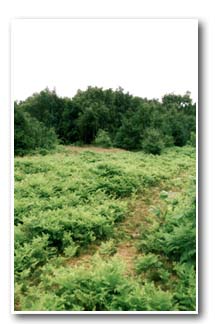
Open
areas can be found within many
of the Heritage Woodlands.
|
Although the Fuelling
a Revolution programme is mainly about woodlands, a number of the
sites contain areas of other habitats
such as grassland, heath, scrub and wetland. In addition, within
the woodlands themselves can often be found valuable habitats such
as ponds, streams, glades and woodland edges. These subsidiary habitats
will be maintained and restored under the Fuelling a Revolution
programme.
On some sites, the clearance of herb species, such as Himalayan
Balsam and Japanese Knotweed is necessary. These non-native species
spread rapidly and can shade out native ground flora and growing
saplings. Control of Bracken is also often required for similar
reasons.
Most of the woodlands contain features
of archaeological and historical interest, in some cases of
national importance. These features will be protected during woodland
management operations. In addition, all woodland management work
will take into account the need to maintain or increase populations
of scarce and diminishing bird and
animal species that occur within the woodlands such as Song
Thrush, Purple Hairstreak Butterfly and Bats.
  
|