|
BOWDEN HOUSTEADS
WOOD - MANAGEMENT
INTRODUCTION
Management work at Bowden Housteads Wood is undertaken by, or on
behalf of, Sheffield City Council who own the site. A management
plan for the wood was developed in 1988, following extensive consultation
with the local community and a revised plan has recently been developed
as part of the Fuelling a Revolution programme.
TREES AND WOODLANDS
The main aim of
woodland management at Bowden Housteads Wood is to promote a structurally
diverse and uneven-aged woodland incorporating a mix of new growth,
dense young trees, and mature and over-mature trees.
For three to
four years immediately following the production of a management
plan for the wood in 1988, an extensive programme of felling took
place in parts of the wood. The main purpose of this was to let
more light through the canopy to the woodland floor, thereby encouraging
the development of the ground flora and shrub layer and the regeneration
of young trees. This work also has the effect of extending the lifespan
and improving the shape of selected canopy trees. A particular focus
of this work was the creation of glades, through the felling of
small groups of trees within the woodland. Areas that have been
managed in this way can be clearly identified by their dense groups
of young trees.
Following the
earlier success of this management work, group felling and thinning
are continuing as part of the Fuelling a Revolution programme.
Native trees
and shrubs typical of ancient semi-natural woodlands, such as Sessile
Oak, Birch, Ash, Wild Cherry, Rowan, Common Alder, Crack Willow,
Hazel and Hawthorn, are being encouraged, using natural regeneration
whenever possible.
In some areas
of woodland, management intervention will be minimal, either in
order to protect species intolerant of disturbance or because management
is not likely to be beneficial. For example, the Willow carr along
the Car Brook will be allowed to develop naturally.
BIODIVERSITY
All management work within
the wood and its surrounding areas will take into account the need
to maintain or increase populations of scarce and diminishing species,
such as Song Thrush, Grey Partridge, Skylark, Pipistrelle Bat, Linnet,
Bullfinch, Spotted Flycatcher, Reed Bunting, Tree Sparrow and Turtle
Dove, many of which are associated with woodland edges. In addition,
berry-bearing trees and shrubs, such as Rowan, Whitebeam, Hawthorn,
Holly, Guelder Rose and Elder, are being encouraged in order to
provide a food source for birds.
Some dead trees
or parts of trees left as a result of woodland management will continue
to be left standing, with other dead wood being left on the woodland
floor to benefit fungi, invertebrates, hole nesting birds and bats.
 |
|
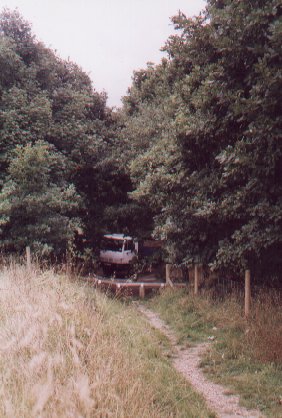
Many
of the paths through the wood have been improved in the recent
past and now provide access for a wide range of users. This
lorry is delivering the material used to resurface the paths.
|
HISTORY AND HERITAGE
An archaeological survey of Bowden Housteads Wood has already taken
place as part of the Fuelling a Revolution programme. Features of
archaeological and historical interest, including woodland boundaries
and areas associated with charcoal making and lead smelting are
now being protected.
ACCESS AND RECREATION
In order to encourage
public access and recreation, the footpath network is being improved,
in particular to facilitate wheelchair access. Waymarking and seating
facilities are also being maintained and improved.
Alongside this,
work will be undertaken to reduce the frequency of inappropriate
activities such as fly-tipping, vandalism and motorcycle scrambling.
To achieve this, access points will be maintained and other parts
of the site boundary will be strengthened.
The local community
and users of the site will continue to be consulted about its management
and encouraged to play an active role in this. In order to raise
awareness of the history and natural history, recreational opportunities
and management of the site, an extensive programme of educational
and interpretative events is being run as part of the Fuelling a
Revolution programme.
More general information on the management
of the woodlands and other habitats and on access
improvements is given elsewhere on this website.
  
|