

The ProgrammeThe WoodlandsLocation MapEventsNewsSchoolsChildrenInteractiveFeedback
The ProgrammeFuelling a Revolution
More information - Wheata Wood, Prior Royd & Birkin Royd
  visiting the wood
  landforms, rocks and soils
  history and heritage
» plants and trees
  vegetation
  birds and animals
  a woodland walk
  educational use
  woodland restoration and
   management work
WHEATA WOOD, PRIOR ROYD & BIRKIN ROYD- PLANTS AND TREES

TREES
Oak is probably the most common tree throughout most parts of Wheata Wood and Prior Royd and in parts of Birkin Royd. Two species, Pedunculate Oak and Sessile Oak, are present. It is likely that, being characteristic of sandy, acid soils on higher ground, Sessile Oak was the original Oak of the area and that Pedunculate Oak, which is more typical of lowland areas, was introduced later by man. Hybrids between these can be found, these sharing the characteristics of both species, having the long-stalked tapering leaves of the Sessile Oak and the long-stalked acorns of the Pedunculate Oak.

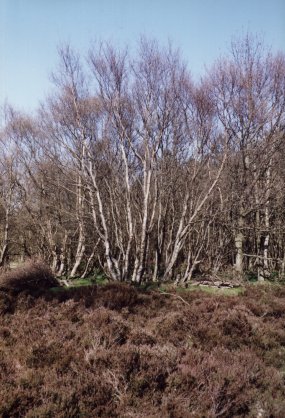
The woods also contain two species of Birch, Downy Birch and Silver Birch, and again a range of hybrids is present. As is often the case, Birches tend to become established first when woodland is developing in an area, these being overtaken by Oaks at a later date.

Other native tree species include scattered Rowan and Wych Elm. Alder, being well suited to areas of wet ground is dominant in wet areas in the lower part of Prior Royd and along Sough Dike.

Significant areas, particularly of Wheata Wood, have over the past 150 years been planted with non-native trees such as Sycamore, Sweet Chestnut, Horse Chestnut and Beech. The last of these was planted extensively in the late 19th and early 20th century in Wheata Wood (especially in the northern limb) and in Prior Royd. Particularly fine Beeches can be found near the car park and at the entrance from Woodhead Road nearest to Grenoside. Sweet Chestnut is also common in parts of Wheata Wood, especially in eastern, roadside areas.

SHRUBS
Dense thickets of Holly occur frequently throughout all three woodlands. These are thought to have
originated as managed sources of winter feed for cattle, known as 'Holly haggs'. Holly is especially frequent in the lower parts of Wheata Wood and is also a feature of the section of Prior Royd close to the ancient Hunter House Farm.

On damp soils beneath Alder the shrub layer contains frequent Hazel and Goat Willow. In addition, Guelder Rose is found in association with wetter areas under Sycamore in Prior Royd.

This picture clearly shows the way in which remaining areas of heath are steadily being invaded by young woodland.

WOODLAND GROUND FLORA
A large number of plant species characteristic of ancient woodlands are found at the site. These 'ancient woodland indicator species' include Bluebell, Dog's Mercury, Yellow Pimpernel, Wood Speedwell, Ramsons, Yellow Archangel, , Wood Sorrel, Sweet Woodruff, Wood Anemone, Remote Sedge, Opposite-leaved Golden-saxifrage and the grasses, Wood Melick and Wood Millet.

A particularly interesting and relatively frequent flower in areas of Oak/Birch woodland and under Sweet Chestnut is the yellow-flowered Common Cow-wheat, a species also thought to indicate ancient woodland, particularly that with a history of coppicing.

Other ground flora species found in the three woodlands include Lesser Celandine and Dog Violet and, in wet places, Angelica, Valerian, Meadowsweet and Green-ribbed Sedge. Many areas of the woodland floor are dominated by grasses, with other areas having abundant Bramble. Because of its dense canopy, Beech tends to inhibit the ground flora, sometimes extinguishing it completely. The ground flora has also been largely suppressed under conifers.

OTHER HABITATS
Heather and Bilberry dominate the small area of heathland between Wheata Wood and Prior Royd.


OTHER PLANTS
Although their dense shade makes them poor in ground flora species, areas dominated by Beech can be rich in fungi. This is particularly the case in Wheata Wood.

A number of ferns and related plants are found in the woodlands, including Lady Fern which occurs in wet places under Sycamore in Prior Royd, and Wood Horsetail, which is found on damp soils under Alder.

MORE INFORMATION
More general information on the plants and trees of the Heritage Woodlands can be found elsewhere on this website.

backBack to Topback