|
WHEATA WOOD,
PRIOR ROYD & BIRKIN ROYD - MANAGEMENT
INTRODUCTION
Management work at Wheata
Wood, Prior Royd and Birkin Royd is undertaken by, or on behalf
of, Sheffield City Council who own the site.
Generally, the
aim of management work in the woodlands is to achieve a balance
between recreational use and the protection of the site's wildlife,
landscape and archaeological interest. However the focus of management
differs somewhat between the three woodlands. In Wheata Wood, priority
is given to the requirements of the public whereas in Birkin Royd,
disturbance of any kind is discouraged. In Prior Royd, the main
focus is on the enhancement of habitat diversity.
 |
|
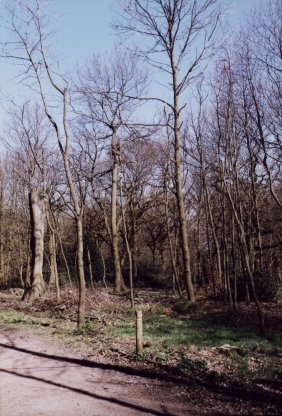
Part of
Wheata Wood thinned during the first year of the 'Fuelling
a Revolution' programme. Since this photo was taken, the vegetation
in this area has already regrown vigorously.
|
TREES AND WOODLANDS
The main aim of woodland management in the three woodlands is to
retain their 'wild' character and landscape value and to enhance
their value as wildlife habitats and areas for recreation.
Native trees
and shrubs typical of ancient semi-natural woodlands, such as Sessile
Oak, Birch, Rowan and Alder are being encouraged, using natural
regeneration whenever possible. In selected areas, thinning and
felling of small groups of trees is being carried out in order to
encourage the development of a more varied woodland structure. This
work will also have the effect of extending the lifespan and improving
the development of selected trees and also of encouraging the development
of the shrub layer and ground flora.
Although Holly
is a native species, highly characteristic of the site, it may be
necessary to control this in some areas in order to improve safety
for those using the area and to prevent the invasion of areas of
diverse ground flora.
Considerable
areas, particularly in Wheata Wood, are currently dominated by non-native
species, such as Beech, Sycamore and conifers. The frequency of
these species will be reduced, especially where the ground flora
and native tree species such as Alder are threatened. Not all non-native
trees will be removed however. Fine old Beech trees will be retained
and the Woodhead Road Beech avenue, an important landscape feature,
will be completed.
In some
areas of woodland, management intervention will be minimal, either
in order to protect species intolerant of disturbance or because
management is not likely to be beneficial.
Where possible,
income will be created from the sale of produce from woodland management
operations. However, this will always be done in a sustainable way
and will be secondary to the interests of wildlife, archaeology,
access and recreation.
NON-WOODED AREAS
Some of the, once much
more widespread, open areas dominated by Heather and Bracken will
be restored, particularly in upper parts of Prior Royd and in adjoining
areas of Wheata Wood.
Where necessary,
wetland habitats, including the streamsides in Birkin Royd will
be enhanced. As part of this, eradication of small areas of invasive
non-native species, such as Japanese Knotweed, may be required.
BIODIVERSITY
A primary aim of all management work within the woods will be to
maintain and enhance habitat diversity and to increase populations
of scarce and diminishing plant and animal species. Some dead trees
or parts of trees left as a result of woodland management work will
continue to be left standing, with other dead wood being left on
the woodland floor to benefit fungi, invertebrates, hole nesting
birds and bats.
In order to continue and enhance their value for wildlife, the three
woodlands have recently been designated as a Local Nature Reserve.
HISTORY AND HERITAGE
Because of its Romano-British remains, much of Wheata Wood has been
designated as a Scheduled Ancient Monument. A detailed archaeological
survey of all three woods has already taken place as part of the
Fuelling a Revolution programme and features of archaeological and
historical interest, including the Romano-British settlement and
the woodland boundaries are now being protected.
ACCESS AND RECREATION
The use and enjoyment
of the woodlands by the public through appropriate recreational
pursuits will be encouraged, particularly in Wheata Wood.
To achieve this,
selected access points and paths will be improved and maintained.
A particular focus of this access work will be to, where practical,
provide access for less able-bodied people, including wheelchair
users.
In contrast
to the above, the character of some of the more remote and inaccessible
areas such as Birkin Royd and adjacent parts of Prior Royd will
be maintained by discouraging access, especially for orienteering
and horse riding.
The local community
and users of the site will continue to be consulted about its management
and actively encouraged to take a part in its care. In order to
raise awareness of the history and natural history, recreational
opportunities and management of the site, an extensive programme
of educational and interpretative events is being run as part of
the Fuelling a Revolution programme, particularly in Wheata Wood.
MORE INFORMATION
More general
information on the management
of the woodlands and other habitats and on access
improvements is given elsewhere on this website.
  
|