|
WHEATA WOOD,
PRIOR ROYD & BIRKIN ROYD - ANIMALS
The highly irregular shape of the three woodlands results in a
long woodland edge relative to their area and this enhances their
value for wildlife; edge habitats frequently being richer and more
diverse in both plants and animals than the communities they lie
between. The juxtaposition of woodland edge and open pasture enables
birds and mammals to exploit the food resources of the grasslands,
while retaining the protection of the woodland, and also enables
plants to benefit from increased light.
INVERTEBRATES
As is the case
with most woodlands of ancient origin, the three woodlands support
a good range of invertebrates. In particular, Sweet Chestnut, though
not a native tree species, supports a wide range of insects.
 |
|
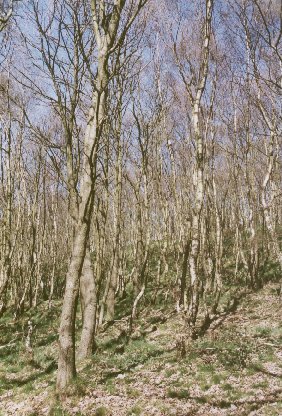
Upper parts
of Prior Royd are popular with Willow Warblers during the
summer, and with Siskins, Redpolls, Bullfinches, Goldcrests
and Long-tailed Tits in the winter.
|
BIRDS
The three woodlands provide a home for a wide variety of birds.
Two birds-of-prey; Kestrel and Sparrowhawk, nest regularly within
the woods. Woodcocks are found in the wetter areas of Prior Royd
and can be seen performing their display flight, known as roding,
over upper parts of Wheata Wood in the early summer.
The more mature
trees of Wheata Wood provide feeding and nesting sites for Tawny
Owl, Green Woodpecker, Greater-spotted Woodpecker, Nuthatch, Treecreeper,
Jay, Blue Tit and Great Tit. The mature Sweet Chestnut trees found
in the eastern part of Wheata Wood often have bosses, crevices and
dead wood which provide valuable nesting sites for birds. Willow
Warblers are abundant in the immature Birches of upper Prior Royd
during the summer. In the winter, Siskins, Redpolls, Bullfinches,
Goldcrests and Long-tailed Tits are to be found here. Chaffinches
and Bramblings can be seen around the field access track and car
park in Wheata Wood where they find food, particularly in the winter.
MAMMALS
The three woodlands
are home to several species of mammal. Foxes are frequent and Badgers
from surrounding areas regularly forage in all three woods, although
there are no known setts within the woodlands. As in most woodlands,
Grey Squirrel are ubiquitous, and evidence of Hedgehog, Mole, Stoat
and Shrew has also been noted. Bats have been observed but the species
have not been identified.
Red Deer have
occasionally been known to use Prior Royd and Wheata Woods, these
being the remnants of a herd originally established in Wharncliffe
Chase and released in the 1940s.
Rabbits are
most common on the slopes of Prior Royd and Hares have been sighted
in adjacent fields, their tracks being frequently found within the
woods.
More general information on the birds
and animals of the Heritage Woodlands is available elsewhere
on this website.
  
|