|
WHEATA WOOD,
PRIOR ROYD & BIRKIN ROYD - EDUCATIONAL USE
INTRODUCTION
Being relatively flat and easily accessible, Wheata Wood is the
most suitable part of the site for educational purposes, particularly
with younger children, and it is already well used for this purpose,
both by local schools and those from further afield. The upper parts
of Prior Royd, which are also relatively easily accessible, provide
a useful contrast to Wheata Wood. In contrast, the lowest parts
of Prior Royd and all parts of Birkin Royd are much less easily
accessible and because of this and their ecologically sensitive
nature should not be used by school groups.
More detailed information to support education work in the woodlands
can be found in the Fuelling a Revolution education pack covering
Wheata Wood, Prior Royd & Birkin Royd. Details on how to obtain
this can be found in the Schools
section of this website.
 |
|
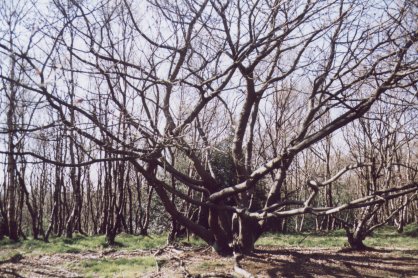
The shape
of this multi-stemmed Oak at the eastern edge of Prior Royd
may date from the time at which the woods were coppiced to
produce charcoal and other woodland products.
|
SUGGESTED
ACTIVITIES FROM THE SCHOOLS SECTION OF THIS WEBSITE
The Schools section of this
website provides units of work covering a wide range of subject
areas and Key Stages. Although, all or most of these units, would
be suitable for use in these woodlands, some are particularly appropriate,
and for this reason, direct links to these downloadable materials
are provided below.
Key Stage 1 Numeracy - 'Use
your Senses'
The relatively
remote nature of the site (particularly compared to some of the
other Heritage Woodlands) makes it particularly suitable for this
unit
of work which explores use of the senses in a woodland environment.
Key Stage 1 Maths - 'Looking
at Leaves'
The wide range of tree species in the woods make
them particularly suitable for this unit with its focus on leaf
shape and symmetry.
Key Stage 2 Literacy - 'Read
All About It'
Devise a leaflet telling users of the site about the woodlands and
describing what they might see when following the trail
described elsewhere in this section of this website.
Key Stage 2 Numeracy - 'Girth
& Gaps'
This unit could be used to compare the trees in open areas of Wheata
Wood with the younger, denser woodland of Prior Royd.
Key Stage 2 Science - 'What
Lives Where?'
All of the animals featured on the pupil sheet for this unit are
known to live in the three woodlands.
Key Stage 2 Science - 'Life
Cycles'
The range of ages of trees on the site makes it ideal for the study
of changes during a tree's life cycle, from seed through sapling
and mature tree to old age, death and decay.
Key Stage 2 Geography - 'Do
you come here often?'
The woodlands are popular places for both formal and informal recreational
activities, some of which are acceptable and others of which are
less so. Its visitor base has been widened by the Trans-Pennine
Trail which runs through the site. This unit could be used to study
recreational activities taking place and to consider potential conflicts
between these and possible effects on the site.
Key Stage 2 Art - 'Signposts'
The development of waymarking is one priority for the woodlands
under the Fuelling a Revolution programme. Children could use this
unit to develop their own designs for this, perhaps based on the
trail described elsewhere in this section
of this website.
Key Stage 2
P.E. - 'Woodland Adventures'
More open areas
of Wheata Wood, in particular those along the Trans-Pennine trail
to the north and south of the car park would be particularly suitable
for this unit. When using these areas, care should be taken not
to damage the site, for example by avoiding areas rich in woodland
wildflowers.
Key Stage 3
Science - 'Woodland Survival'
Examples of all of the different adaptations to woodland
life listed on the pupil sheet can be found in the three woodlands.
Key Stage 3 Science - 'Are
All Woods the Same?'
An area of mature trees in Wheata Wood could be contrasted with
an area of younger trees at the top end of Prior Royd.
Alternatively,
areas dominated by tree species native to the area (such as Oak
and Birch) could be contrasted with those dominated by non-native
species (e.g. Beech, Sweet Chestnut or conifers).
Finally, a comparison
could be made between the the edges and interior of the woodland,
and between this and adjacent areas of open space.
Key Stage 3
Science - 'Tree of
Life'
The existence of woodland areas dominated by single species (e.g.
Oak, Beech, Sweet Chestnut or Sycamore) makes this a good site for
this unit considering one tree species and its associated flora
and fauna.
Key Stage 3
Science - 'What causes
plants to change?'
The frequent occurrence of Holly at the site provides ample opportunity
for the study of environmentally caused variations in leaf shape.
Key Stage 3 Geography -
'Woodland Climates'
Examine the effect of changing altitude and woodland structure on
local climate by taking measurements along a transect running through
Wheata Wood and downhill to the lower edge of Prior Royd.
Key
Stage 3 Art & Design - 'Recreating
Woodlands'
Combine
observations made within the woodlands with views from the woodland
edges into a textile design based on the natural world.
Key Stage 3
Art - 'Fuelling a Revolution'
Being heavily used by the public, Wheata Wood could provide a good
venue for the design of sculpture for a woodland site.
In addition, other useful resources from the Fuelling a Revolution
education packs and from 'get, set... Grow', the South Yorkshire
Forest schools' pack, can be downloaded from Downloadable
Pupil and Teacher Resources for Key Stage 2 in the Schools section
of this site.
The 'Tree File' CD ROM that accompanies the 'get, set... Grow'
pack contains identification details and background information
for all of the major tree and shrub species found in the wood including
Oak, Beech, Sweet Chestnut, Sycamore, Birch, Holly, Hazel and Alder.
For further information, go to the section on printed
education materials in the Schools section of this website.
OTHER
ACTIVITIES
Key Stage 3 Science
The development of Oak/Birch
woodland could be examined by comparing a number of different locations,
including:
1. The heathland
area between Wheata Wood and Prior Royd, which is being invaded
by Birches.
2. Upper areas of Prior Royd where stands of dense, even-aged, birch
act as a 'nurse-crop' for the Oaks which grow tall and straight
in the light shade of the Birch. Former heathland vegetation is
still clearly evident under the trees here.
3. The central area of Wheata Wood where there is a canopy of mature
Birch and young Oaks, together with scattered Rowan, Sweet Chestnut
and Holly.
4. Mature Oak/Birch communities in lower parts of Wheata Wood where
there are tall, mature, single trunked Oaks with over-mature Birches.
The species
composition and structure of these areas could be compared using
quadrats and by drawing cross-section diagrams.
Key Stage 3
Science
Study the effect of recent woodland management in Wheata Wood on
the diversity of the ground flora.
Place metre
square quadrats randomly in three or four different areas, for example:
- An area coppiced,
thinned or group felled recently, preferably within the past year.
- An area coppiced,
thinned or group felled two to five years ago.
- An area coppiced,
thinned or group felled between five to fifteen years ago and
in which there has been a considerable amount of tree regeneration.
- An area of
'high forest' where coppicing, thinning or group felling has not
taken place in the recent past. (the control)
Record light
and temperature levels, soil type and pH and measure the percentage
cover of selected species and of all plant species taken together.
Correlate this data with light levels using scattergraphs or other
methods of comparison. If Dog's Mercury is present in the area,
it may be possible to relate the number of shoots to light intensity.
  
|