|
CLIFFE WOOD
- EDUCATIONAL USE
INTRODUCTION
As a result of
its range of habitats and its central location, Cliffe Wood is an
excellent site for schools work. It has been extensively used as
an education resource by both primary and secondary schools in the
past and this is continuing to develop under the 'Fuelling a Revolution'
programme.
More detailed
information to support education working the wood can be found in
the Fuelling a Revolution education pack covering Cliffe Wood. Details
on how to obtain this can be found in the Schools
section of this website.
SUGGESTED
ACTIVITIES FROM THE SCHOOLS SECTION OF THIS WEBSITE
The Schools section of this
website provides units of work covering a wide range of subject
areas and Key Stages. Although, all or most of these units, would
be suitable for use in Cliffe Wood, some are particularly appropriate,
and for this reason, direct links to these downloadable materials
are provided below.
 |
|
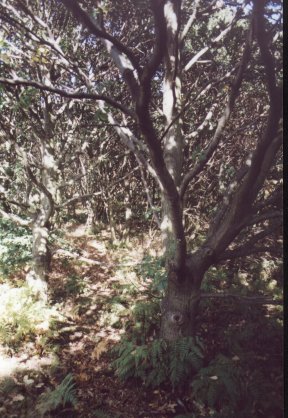
Oak-dominated
woodland at Cliffe Wood.
|
Key Stage 1
Literacy- 'Woodland
Tales'
The presence of abundant gnarled and multi-stemmed oaks, particularly
on upper parts of the site might form a useful stimulus for this
unit.
Key Stage 1
Science - 'Plants
& Animals'
The proximity of the wood to areas of open ground makes it ideal
for this unit comparing the flora and fauna of wooded and non-wooded
areas.
Key Stage
1 Geography- 'Our
Local Wood'
Being situated close to residential areas, Cliffe Wood could be
easily incorporated by nearby schools into a walk around their local
area.
Key Stage
2 Science- 'What
Lives Where?'
The wide variety of habitats in or adjacent to Cliffe Wood makes
it ideal for this unit which considers where different animal species
find shelter, food and water.
Key Stage 2
Geography-'Do
you come here often?'
Because of its location, Cliffe Wood is extensively used for recreation
by local people. This could be studied in the context of Dearne
Valley Park as a whole, the lakes of which are extensively used
for fishing.
Key Stage 2
Art-'Signposts'
Waymarking for the site could be developed, perhaps using the trail
provided elsewhere on this website.
Key Stage 3
Science - 'Are
all woods the same?'
A wide variety of contrasting areas are available for comparison
in the wood, including:
· dry areas and riversides
· semi-natural Oak/Birch woodland and the more recently established
plantation area
· the edges and interior of the wood
· woodland and adjacent open space
Key Stage 3
Geography-'Woodland
Climates'
Measurements could be made at points along a transect from the top
of the site down to the lakes. The effect on local climate of altitude,
woodland structure and proximity to water could then be evaluated.
Key Stage 3
Art 2 - 'Fuelling
a Revolution'
Being heavily used by the public, Cliffe Wood could provide a venue
for the design of sculpture for a woodland site.
OTHER
ACTIVITIES
Key Stage 3
Science
Cliffe Wood is a good site at which to investigate genetic variation
in Oak trees. Both Pedunculate and Sessile Oaks are frequent on
the site as are hybrids between these. These hybrids share the characteristics
of both species, having the long-stalked tapering leaves of the
Sessile species and the long-stalked acorns of the Pedunculate.
Study leaf shape and carry out measurements of leaf and acorn stalks
in order to differentiate between the two species and their hybrids.
In addition,
other useful resources from 'get,
set … Grow', the South Yorkshire Forest schools' pack,
can be downloaded from Downloadable Pupil and Teacher Resources
for Key Stage 2 in the Schools
section of this site.
The 'Tree File'
CD ROM that accompanies the 'get, set … Grow' pack contains
identification details and background information for all of the
major tree and shrub species found in the wood including Birch,
Elder, Hazel and Oak. For further information, go to the section
on printed education materials in the Schools section of this website.
  
|