|
CLIFFE WOOD
- MANAGEMENT
INTRODUCTION
In common with
the rest of Dearne Valley Park, management work at Cliffe Wood is
undertaken by or on behalf of Barnsley Metropolitan Borough Council
who own the area.
The main management
objective for Dearne Valley Park as a whole is to maintain and enhance
the present diversity of habitats. A management plan for Cliffe
Wood itself will be prepared under the 'Fuelling a Revolution' programme.
More general
information on the management of the woodlands
and other habitats
and on access improvements
is given elsewhere on this website.
TREES
AND WOODLANDS
 |
|
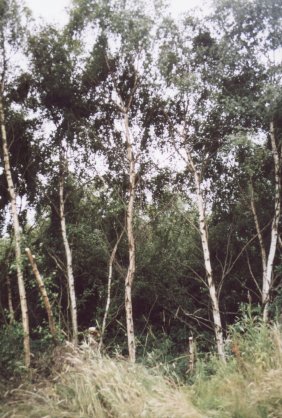
Birches
on the edge of the route of the old canal.
|
Selective felling
of trees will be used to open up areas of closed tree canopy in
which the shrub layer and ground flora are declining through lack
of light. This will be particularly the case in the plantation area.
Thinning of this kind will also have the effect of extending the
lifespan of selected canopy trees and making room for their natural
regeneration.
Native tree
species typical of ancient semi-natural woodlands, such as Sessile
Oak, Birch, Ash, Wild Cherry, Rowan, Common Alder, Crack Willow,
Hazel and Hawthorn, will be encouraged, by means of natural regeneration
whenever possible.
In all wooded
areas of the site, tree inspections will be carried out and any
hazardous trees close to paths will be made safe. Where possible
however, both standing and fallen deadwood will be left on the site
to provide a habitat for wildlife.
In some areas
of woodland, management intervention will be minimal, either in
order to protect species intolerant of disturbance or because management
is unlikely to be beneficial.
NON-WOODED
AREAS
Glades and rides will continue to be maintained. Invasive species
such as Himalayan Balsam will be controlled. In addition, some tall
herbs will be cleared from wetland areas in order to increase the
diversity of wetland plants.
BIODIVERSITY
As part
of the 'Fuelling a Revolution' programme, an ecological survey of
the site will be undertaken. This will help to inform management work
carried out on the site. All management work within the wood and its
surrounding areas will take into account the need to maintain or increase
populations of scarce and diminishing species, such as Song Thrush,
many of which are associated with woodland edges.
HISTORY
AND HERITAGE
An archaeological
survey will be undertaken as part of the 'Fuelling a Revolution'
programme. Features of archaeological and historical interest will
then be protected.
ACCESS AND
RECREATION
In order to encourage
public access and recreation on the site, the footpath network will
be maintained and improved. Wheelchair access to parts of the site
will be maintained and where possible, improved. In addition, seating
will be installed and waymarking and interpretative signs erected.
Rubbish removal
will continue to take place on a regular basis and work will be
undertaken to reduce the frequency of fly-tipping, vandalism and
motorcycle scrambling. To achieve this, access points will be maintained
and other parts of the site boundary, in particular along Rotherham
Road will be strengthened.
In order to
raise awareness of the history and natural history, recreational
potential and management of the site, a programme of educational
and interpretative events is being run as part of the 'Fuelling
a Revolution' programme. The local community and other users of
the site will be consulted about its management and encouraged to
play an active role in this.
More general information on the management
of the woodlands and other habitats and on access
improvements is given elsewhere on this website.
  
|