|
CLIFFE WOOD -
PLANTS AND TREES
TREES
The majority
of the site is covered by dry, acidic, semi-natural Oak/Birch woodland.
Approximately three-quarters of the trees in this type of woodland are
Oaks, these being of two species, Sessile Oak and Pedunculate Oak. The
next most frequent tree is Silver Birch, which makes up approximately
20% of the woodland. As a rule, the proportion of Birch in the mix tends
to increase towards the upper edge of the site as the soils become more
acidic and freely drained. Other tree species present in these woodland
areas include Ash, Hawthorn and Field Maple. In parts of the woodland,
many of the trees are both multi-stemmed and heavily stunted. This is
due both to the acidity of the soil and a past history of coppicing.
The mixed plantation
area in the south-western part of the site contains a wide range of deciduous
tree species including Ash, Beech, Oak, Birch, Willow, Hawthorn, Crab
Apple, Alder and Rowan.
The area of wet woodland
on the banks of the River Dearne, is dominated by Willows, including Goat
Willow, Crack Willow and Common Sallow. Other tree species in this area
include Hawthorn, Sycamore and Elder.
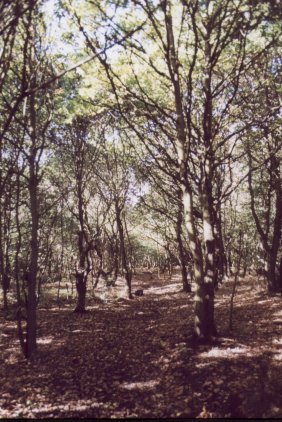 |
|
An area of open woodland in the northern part of the site.
|
SHRUBS
The dominant shrub
in the semi-natural woodland area is Hazel. In the north-west corner of
the site and in the eastern part of the wood, Hazel coppice is a common
feature. This dates from the cutting received during various miners' strikes,
when Hazel and other trees were used as a source of firewood.
Bramble is also a
significant element in lower parts of the shrub layer. Smaller amounts
of Holly and Elder also occur in the wood.
Hazel and Elder are
also present in the mixed plantation area in the south-west of the site.
GROUND FLORA
On the dry, acidic
soils underlying the semi-natural Oak/Birch woodland, Bracken is often
the dominant ground flora species. Beneath this can be found a variety
of grasses, including Creeping Soft-grass and Wavy Hair-grass. These are
accompanied by a range of ancient woodland indicator species, including
Wood Sage, Bluebell, Bush Vetch, Bugle, Yellow Archangel, Dog's Mercury,
Slender St John's-wort and Toothwort.
The field layer in
the plantation area is also dominated by Bracken and Grasses. In a few
places in the west of this area, Honeysuckle can be found climbing on
Hawthorn.
The ground flora
in the area of wet Willow woodland is tall and lush, with Nettle, Bittersweet,
Bindweed, Burdock, the introduced species, Himalayan Balsam, and an abundance
of Hemlock Water-dropwort, a rare plant in the Barnsley area.
NON-WOODLAND HABITATS
As well as woodland,
the site has a number of other habitats including scrub, grassland, marsh
and open water. As a result of this variety of habitats, the site supports
a large number of non-woodland plants.
The wide, mown grassy
rides which break up the areas of woodland and which include the old route
of the Barnsley canal, are fringed by long grass with Bramble, Wood Sage,
Rosebay Willowherb and Bracken. The last of these is particularly dominant
on the lower bank of the old canal towards the eastern end of the site.
Open grassy areas associated with scrub support Rosebay Willowherb, Hogweed,
Thistle, Burdock, Bindweed, Ragwort, Goosegrass, Ox-eye Daisy, Docks,
Japanese Knotweed, Nettle and Rose.
Small, open areas
of marshy grassland close to the River Dearne are of particular interest,
supporting Common-spotted Orchid, Greater Reedmace, Soft Rush and Lesser
Pond-sedge, a rare plant in the Barnsley area.
Just outside Cliffe
Wood are a series of pools and small lakes, fringed with Willow, Rushes,
Great Reedmace and Greater Willowherb. Lesser Water-parsnip occurs in
the water.
More general information on the plants
and trees of the Heritage Woodlands can be found elsewhere on this
website.
OTHER
PLANTS
A wide variety of fungi can be found on the site, including Shaggy Ink-cap,
Common Earth-ball, Puffball, and the characteristic red and white spotted
Fly Agaric.
  
|