|
GIBBING
GREAVE & HERRINGTHORPE WOODS - MANAGEMENT
INTRODUCTION
Management work at Gibbing
Greave and Herringthorpe Woods is undertaken by, or on behalf of,
Rotherham Metropolitan Borough Council who own the site.
A management
plan for the site was prepared in 1996 and this will be updated
as necessary in order to realise the full potential of the woods.
TREES AND WOODLANDS
A major aim in both areas
of woodland is to enhance their ancient semi-natural character.
The plantation
areas, which have been unmanaged for several decades, are currently
in a very poor condition and in these areas, measures will be taken
to extend the life-span and improve the quality of the better formed
existing trees, such as mature Oaks and Sweet Chestnuts; as well
as to encourage the growth of replacements and the recovery of the
ground flora and shrub layers. This will be done by the selective
thinning and group felling of Beech and Sweet Chestnut. The aim
of this work is to encourage the development of a woodland with
trees of a variety of ages and sizes and a mix of species, especially
of native trees such as Oak, Rowan, Birch, Holly, Hawthorn and Hazel.
 |
|
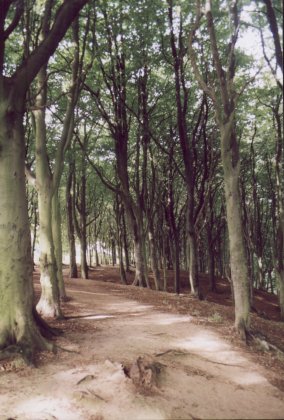
An
area of Beech plantation in Gibbing Greave
clearly showing the extent of bare ground
|
Natural regeneration
will be the main method of providing new trees. Planting, for example
of Hazel, Hawthorn and Holly, will only be considered if natural
regeneration fails to appear after the opening up of the tree canopy.
Outside the
plantation areas, work will be directed at maintaining and strengthening
the character of the more semi-natural parts of the site. Some thinning
and group-felling will be carried out in order to extend the life
of the best formed trees, in particular, of Oak, Beech and Ash,
and to promote regeneration of young trees. The non-native species,
Sycamore will be particularly favoured for removal.
Although Gibbing
Greave and probably Herringthorpe Wood were once managed as coppice
woodland, there is no surviving coppice within the woodlands today.
Reintroduction of coppicing would be unrealistic because of the
present woodland structure and the relative absence of typically
coppiced shrubs such as Hazel.
The area of
Alder carr in the north of Herringthorpe Wood will be left to develop
naturally. Sycamores around the edge of this area will be thinned,
and the highly invasive species, Japanese Knotweed, will be controlled.
Trees of Hybrid Black Poplar growing along streams will be removed
as they become dangerous and replaced by native species such as
Ash, Alder, Willow and Hazel.
Large, mature and over mature trees are rare on the site, and those
that exist are concentrated in the northern part of Gibbing Greave.
All trees of this kind will be retained, and away from paths, allowed
to die, collapse and decay naturally. The same applies to fallen
dead wood which is extremely scarce on the site. Both standing and
fallen deadwood are of value as a habitat for fungi, invertebrates,
hole-nesting birds and bats.
Trees close to paths and access points will be inspected annually
for signs of damage and disease and safety measures required will
be taken.
NON-WOODED AREAS
The glade within Gibbing
Greave is one of the most important wildlife areas in the woodlands
and, in the short-term at least, will be allowed to develop naturally.
A photographic record will be kept to monitor any changes in the
vegetation.
The small marshy
area dominated by Reed Sweet-grass on the edge of the Alder carr
is fringed by mown grassland. The area will be encouraged to expand
by not cutting the grass immediately around it. In addition, the
invasive non-native species, Japanese Knotweed will be controlled.
BIODIVERSITY
Both woods will be managed
to conserve and enhance their natural history and to maintain or
increase their populations of key plants and animals. To achieve
this, the semi-natural characteristics of the vegetation will be
promoted.
Although some
surveys of the wildlife interest of the woodlands have already been
undertaken, further surveys are required to increase knowledge of
the species present and to assist in the development of future management
plans. Surveys to monitor ecological change are also required, in
particular photographic monitoring of and invertebrate surveys in
the glade in Gibbing Greave.
HISTORY AND HERITAGE
Research will be undertaken into the archaeology of the woodlands,
following which features of archaeological and historical interest
will be protected.
ACCESS AND RECREATION
Both woods will be managed
in order to provide safe and appropriate public access and recreation.
Formal access points and paths will be maintained and the use of
other access points and paths will be discouraged.
New boundary
hedgerows will be planted and existing neglected hedgerows rejuvenated.
Hopefully these renewed boundaries will help to deter motorcyclists,
mountain bikes, horse riders and those responsible for fly tipping
and the abandonment of burnt out cars on the site. It is also hoped
that anti-social activities such as glue sniffing, shooting of wildlife
and general vandalism will be reduced. Litter will be removed from
the site on a regular basis.
Access to the
woods will be improved by upgrading the path system. A particular
focus of access work will be to provide access for less able-bodied
persons where this is practical. Steps are required in several places
where soil erosion has occurred and paths will be waymarked where
appropriate. Maintenance work will continue to take place on paths,
bridges and the wooden boardwalk through the area of Alder carr.
Until recently, the two woods had few formal access points but now
most formal access points into have been provided with gates and
stiles.
Interpretative signs will be installed and further sculptures and
pieces of environmental art will be developed similar to those already
on the site.
The local community will be encouraged to become involved in the
care and management of the site. Management works carried out in
the woodlands will be notified to and discussed with the local community.
The potential
of the site as an educational and environmental arts resource is
being developed through guided walks, events relating to the natural
history and historic interest of the site, children's events and
practical management tasks.
More general information on the management
of the woodlands and other habitats and on access
improvements is given elsewhere on this website.
  
|