|
GIBBING
GREAVE & HERRINGTHORPE WOODS - ANIMALS
The domination, for the past century, of major parts of both woods
by planted non-native trees such as Beech and Sweet Chestnut has
led to a substantial decline in the quality and wildlife value of
previously semi-natural areas. Despite this however, both woods
are still of value for wildlife and just over 300 species of animal
have been recorded from the site. Areas of particular value for
wildlife are the semi-natural Oak-dominated woodland and natural
glade in Gibbing Greave, the Alder carr in Herringthorpe Wood, and
the streamside habitats in both woodlands
INVERTEBRATES
Between them, Gibbing
Greave and Herringthorpe Woods support a wide variety of invertebrates,
including at least 54 beetles and 78 species of butterflies and
moths.
Gibbing Greave
supports a greater range of invertebrates and more significant species
than Herringthorpe Wood, although whether this is due to more recording
of its wildlife or to the way in which it has been less affected
by plantation forestry is unclear. The glade in the centre of Gibbing
Greave is particularly valuable for invertebrates and supports a
large number of the site's recorded invertebrate species.
Several of the
invertebrates recorded are nationally rare. These tend to be species
that depend on the woodland plants, dead wood and its associated
fungi, and the wetland areas. They include a solitary wasp which
nests in rotten wood, and a species of cranefly found in the area
of Alder carr.
The uncommon
Speckled Wood butterfly, which loves dappled sunlight, has colonised
a recently created glade in Herringthorpe Wood.
|
|
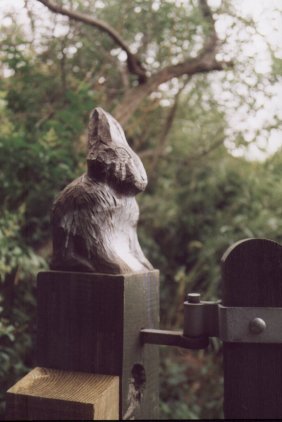
Rabbit
carved on the gatepost leading from Brookside into Herringthorpe
Wood
|
BIRDS
The bird fauna of the
two woods is, in comparison to that of other Heritage Woodlands,
relatively unrecorded. However, the birds that are known to be present
include a range of species reflecting the variety of habitats available
on the site.
Robin, Blackbird,
Long-tailed Tit, Blue Tit and Coal Tit are known to breed in the
woods, with standing deadwood also providing nesting sites for Tawny
Owl, Green Woodpecker and Greater-spotted Woodpecker.
Wren, Chaffinch,
Redwing and tit species prefer the woodland edge habitats as well
as adjacent hedgerows and areas of scrub. Many of these birds supplement
their food supply from adjoining residential areas.
Willow
Tit and Woodcock prefer damp, marshland areas, like the Alder carr
in Herringthorpe Wood. However, neither of these species is known
to breed at the site.
Other bird species
include birds of prey such as Sparrowhawk and Kestrel; and summer
visitors such as Cuckoo, Blackcap and Willow Warbler; as well as
Song Thrush, Mistle Thrush, Tree Sparrow, Redpoll, Greenfinch, Goldfinch,
Chaffinch and Brambling, which feeds on beech mast.
MAMMALS
The only mammals
recorded with certainty from the two woodlands are Grey Squirrel
and Common Shrew. However, bats and Foxes may also be present.
More general
information on the birds and animals
of the Heritage Woodlands is available elsewhere on this website.
  
|