WOOLLEY
WOOD - EDUCATIONAL USE
INTRODUCTION
Woolley Wood has considerable potential for educational use, especially
as it is easily accessible and situated close to a densely populated
area.
More detailed information to support education work in the wood
can be found in the Fuelling a Revolution education pack covering
Woolley Wood. Details on how to obtain this can be found in the
Schools section of this website.
SUGGESTED
ACTIVITIES FROM THE SCHOOLS SECTION OF THIS WEBSITE
The Schools section of this
website provides units of work covering a wide range of subject
areas and Key Stages. Although, all or most of these units, would
be suitable for use in Woolley Wood, some are particularly appropriate,
and for this reason, direct links to these downloadable materials
are provided below.
|
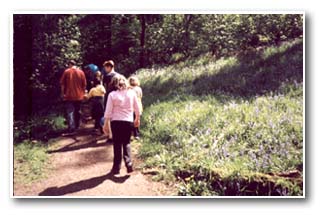
Woolley
Wood is particularly good for school visits
in the spring when the bluebells are in flower.
|
Key Stage 1 Numeracy-'Looking
at Leaves'
The wide range of tree species at the site makes it a particularly
useful resource for this unit, which deals with leaf sizes and shapes,
with a focus on symmetry.
Key Stage 1 Science - 'Plants
and Animals'
This unit could be used to compare the wildlife of the woodland
with either your own school grounds or the open areas of Concord
Park immediately adjacent to the wood.
Key Stage 1 Geography- 'Our
Local Wood'
Being situated close to residential areas, the wood could form part
of a route around the local area.
Key Stage 2 Literacy-'Read
All About It'
Devise a leaflet telling users of the site about the woodland and
describing what they might see when following the trail
through the wood.
Key Stage 2 Science-'Life
Cycles'
The range of ages of trees on the site makes it ideal for the study
of changes during a tree's life cycle, from seed through sapling
and mature tree to old age, death and decay.
Key Stage 2 Geography -
'Do
you come here often?'
The woodland is a popular place for formal and informal recreation,
being used for a wide range of recreational activities, some of
which are acceptable and others of which are less so. This unit
could be used to study recreational activities taking place and
to consider potential conflicts between these and possible effects
on the site.
Key Stage 2 Art - 'Signposts'
Waymarking for the site could be developed perhaps using the trail
as a basis.
Key Stage 3 Science - 'What
causes plants to change?'
The occurrence of holly at the site provides an opportunity for
the study of environmentally caused variations in leaf shape.
Key Stage 3 Geography-'Woodland
Climates'
Use this unit to compare the climate of various points up the slope
of Woolley Wood with the higher and much more exposed area of Concord
Park.
In addition, other useful resources from the Fuelling a Revolution
education packs and from 'get, set... Grow', the South Yorkshire
Forest schools' pack, can be downloaded from Downloadable
Pupil and Teacher Resources for Key Stage 2 in the Schools section
of this site.
The 'Tree File' CD ROM that accompanies the 'get, set... Grow'
pack contains identification details and background information
for all of the major tree and shrub species found in the wood including
Ash, Alder, Beech, Birch, Elder, Hazel, Holly, Hornbeam, Oak, Sycamore,
Wild Cherry and Yew. For further information, go to the section
on printed education materials
in the Schools section of this website.
OTHER
ACTIVITIES
Key Stage 3 Science
Woolley Wood is a good site at which to investigate genetic variation
in Oak trees. Both Pedunculate and Sessile Oaks are frequent on
the site as are hybrids between these. These hybrids share the characteristics
of both species, having the long-stalked tapering leaves of the
Sessile species and the long-stalked acorns of the Pedunculate.
Study leaf shape and carry out measurements of leaf and acorn stalks
in order to differentiate between the two species and their hybrids.