WOOLLEY
WOOD - MANAGEMENT
INTRODUCTION
For a long time after coming into public ownership in 1925, Woolley
Wood underwent relatively little management. However, with increasing
pressures on the wood through mis-use, together with the encroachment
of invasive species, such as Sycamore, acive management of areas
within the wood has now become necessary in order to prevent their
decline.
A management and development plan for the site was prepared in
1993 and a new management plan for the site is currently being prepared.
Much of the management work taking place in the wood is carried
out by The North Sheffield Conservation Group working together with
the wood's owners, Sheffield City Council.
TREES AND WOODLANDS
|
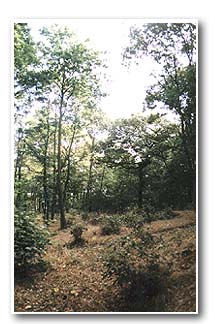
A glade
created by thinning of selected trees
and showing the regrowth from the cut stumps.
|
Woodland management in Woolley
Wood seeks to maintain the current diversity of tree species. Areas
of Hornbeam and Yew will be maintained as these are of value to wildlife,
and in particular birds. Steps will however be taken to improve the
shrub layer and ground flora beneath these.
A limited programme of tree thinning has taken place in parts
of the wood in order to allow greater amounts of light through the
tree canopy. Sycamores have been particularly selected for felling
as this is a very invasive non-native species which supports relatively
little wildlife. The glades created by the removal of Sycamore tend
to become invaded by Bracken and because of this a programme of
Bracken control is being implemented. Eventually, it is hoped that
locally native trees will spread naturally into the areas cleared
of Sycamore although this will need to be augmented by planting.
Some sunny glades will however be kept open to increase diversity
of habitat.
Natural regeneration will be the main method of providing new
trees. Little planting will need to be carried out in most areas
as most tree species present in the wood seem to be successful in
reproducing themselves. Exceptions to this are Hazel and Wild Cherry,
which due to limited natural regeneration may need to be planted.
Tree planting will also be required in order to increase the proportion
of native tree species in areas currently dominated by Sycamore.
A limited amount of planting may also need to be carried out to
improve the shrub layer in areas of shade created by Hornbeam, Beech
and Yew.
All trees close to paths and access points will be inspected regularly
for signs of damage and disease and any safety measures required
will be carried out.
Ultimately, parts of the wood cut off from the main part of the
wood by golf course fairways may be brought back into the woodland.
The woodland might also be encouraged to spread back into open areas
of grassland and scrub at its northern and southern ends.
NON-WOODED AREAS
Investigations will be carried out into water quality in streams
within the wood and if necessary steps will be taken to improve
this. Certain marshy areas within the wood could be enhanced as
wetland habitats, possibly by damming streams to increase the size
of their associated marshy areas.
BIODIVERSITY
Although the birds and trees and shrubs of Woolley Wood are well
recorded, there is much less known about other groups of plants
and animals. For example, detailed surveys of spring flowers, mosses,
liverworts, lichens and ferns are required. In addition, relatively
little is known about the woodland's invertebrates and a detailed
survey of amphibians and woodland mammals is also required, particularly
for bats. Regular surveys will help to monitor the effects of changing
management within the wood.
The wood will continue to be managed to conserve and enhance its
natural history and to maintain or increase its populations of key
plants and animals. Regular surveys will help to monitor the effects
of changing management within the wood. Several species which occur
in Woolley Wood are relatively rare and these will be afforded special
protection.
Both standing and fallen deadwood are of value as a habitat for
fungi, invertebrates, hole nesting birds and bats. When felling
is taking place, trunks will where possible be left on site, or
stacked in 'habitat piles', and left to rot.
Access to 'The Ravine', which provides a sanctuary area for birds
and other wildlife, will be discouraged by the creation of viewpoints
on the perimeter of the area.
The planting of berry bearing shrubs around the fringes of the
wood would also be of considerable benefit, particularly to migrant
birds.
HISTORY AND HERITAGE
A survey to determine the archaeological and historical value of
the site has recently been undertaken. Features identified during
this will be protected.
ACCESS AND RECREATION
Woolley Wood is well used by local people, mainly for dog walking,
jogging and bird watching but also for orienteering. It also suffers
from mis-use through air gun use, litter accumulation, vandalism,
damage to footpaths and vegetation by motorcyclists and occasionally
horse riders. Access work will encourage those activities which
do not damage the woodland, whilst at the same time discouraging
those activities which do.
Access points to the site have been or will be furnished with
vehicle barriers, stiles and other features that allow pedestrian,
pushchair and wheelchair access, whilst excluding horses, motorbikes
and other vehicles. Away from these access points; fences, hedges,
barriers or walls will be erected around the boundary.
A programme of footpath improvement was started in 1991/2 and
further steps will be taken to improve pedestrian access for all
sectors of the community. A particular focus of the access work
will be to provide further access for less able-bodied people where
this is practical. Signs, information boards, waymarking and robust
seating will continue to be installed at strategic points.
Work to involve the local community and schools in the care, management
and development of Woolley Wood will continue and the woodland managers
will continue to consult with local people on development and management
issues, particularly when updating the management plan for the wood.
The potential of the site as an educational resource is being
developed through guided walks, events relating to the natural history
and historic interest of the site, children's events and practical
management tasks. Woolley Wood has in the past been used as an important
educational resource and this will continue under the Fuelling a
Revolution programme. Local schools will be encouraged to take part
in both study and practical tasks within the wood.
More general information on the management
of the woodlands and other habitats and on access
improvements is given elsewhere on this website.