

The ProgrammeThe WoodlandsLocation MapEventsNewsSchoolsChildrenInteractiveFeedback
The ProgrammeFuelling a Revolution
More information - Hail Mary Hill & Falconer Woods
  visiting the wood
  landforms, rocks and soils
  history and heritage
» plants and trees
  vegetation
  birds and animals
  a woodland walk
  educational use
  woodland restoration and
   management work
HAIL MARY HILL & FALCONER WOODS - PLANTS AND TREES

TREES
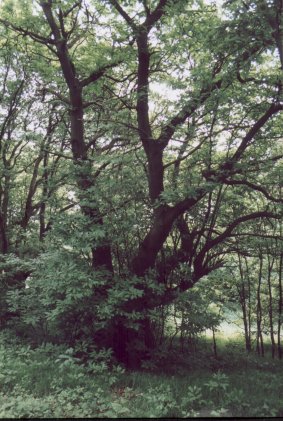
The native trees Sessile Oak and Silver Birch are the dominant trees across the majority of the site. Other native species that occur in smaller quantities include Field Maple, Rowan, Goat Willow, Crab Apple, Whitebeam, English Elm and Wych Elm. Since the middle of the 19th century, these native species have been joined by Beech, Sweet Chestnut and Sycamore, trees that are not native in the area but which have been introduced here by man.

In wetter, more nutrient rich areas of woodland, the balance of tree species is different from that elsewhere. Alder, Ash and Sessile Oak become dominant, together with smaller amounts of Rowan, English Elm, Sycamore, Field Maple and Wild Cherry. On the wettest ground, for example that along Treeton Brook, these are joined by Crack Willow, Grey Willow, Wych Elm, Balsam Poplar and Crab Apple.

Sweet Chetnut tree in Falconer Wood
A fine Sweet Chestnut tree in the southern part
of Falconer Wood.

Trees range from short, twisted and multi-stemmed specimens to tall and well-formed standards. As a general rule the trees in Hail Mary Hill and Falconer Wood are older than those in nearby Treeton Wood, which experienced extensive felling in the middle of the 20th century. The more recent tree felling works associated with the various overhead transmission lines that cross the woodland have created significant areas of open space within the woodlands. The stumps of the felled trees, which include Birch, Oak and Goat Willow, are now regrowing rapidly.

SHRUBS
Shrubs are rare in the areas of dry acid woodland that make up the majority of the site. Despite this, species that can be found include Holly, Hawthorn, Elder, Dog Rose, Hazel and Broom.

Woodland edges and wetter, nutrient rich areas have a significantly richer shrub layer. Bramble becomes frequent, along with Hazel, Hawthorn, Elder, Holly, Guelder Rose and Dogwood.

WOODLAND GROUND FLORA
The woodland contains a number of species that are largely restricted to ancient woodlands. These 'ancient woodland indicator species', which include Bluebell, Dog's Mercury, Greater Stitchwort, Opposite-leaved Golden Saxifrage, Pignut, Ramsons, Wood Anemone, Wood Sorrel, Yellow Archangel and Yellow Pimpernel, are most commonly found in lighter, more nutrient rich places. Several woodland indicators, including Dog's Mercury and Yellow Archangel, are restricted to woodland edges.

In wetter, nutrient rich areas such as that along Treeton Brook there is an abundance of the ancient woodland indicator species listed above, together with Meadowsweet, Lesser Celandine, Angelica, Red Campion and Reed Canary-grass. A particularly unusual ancient woodland indicator, found in the area of woodland close to Treeton Brook, is Moschatel or Townhall Clock, the latter name deriving from the way in which the flower faces in four different directions.

The ground flora in areas of dry, acid woodland is, as a rule, rather species poor. Plants typically found here include Bluebell, Greater Stitchwort, Honeysuckle, Heath Bedstraw, Wavy-hair Grass and Creeping Soft-grass.

OTHER HABITATS
The acid grassland areas on the summit of Hail Mary Hill is dominated by Wavy-hair Grass together with smaller amounts of Heather, Heath Bedstraw, Field Woodrush and the grasses Sheep's Fescue and Common Bent. This currently open area is being gradually encroached upon by Bracken and young trees.

The wetland area of Treeton Marsh has a wide variety of wetland plant species including Soft Rush, Greater Reedmace, Great Willowherb, Common Reed, Marsh Marigold, Water Forget-me-not, Gypsywort, Water Plantain, Angelica, Bittersweet and Reed Canary-grass. In addition, the non-native and highly invasive species Himalayan Balsam is invading the area.

OTHER PLANTS
The fern, Bracken occurs widely throughout the site. The woodland also contains a wide variety of fungi, these being found in both open and closed woodland areas and in areas of acid grassland.

MORE INFORMATION
More general information on the plants and trees of the Heritage Woodlands can be found elsewhere on this website.

backBack to Topback