|
HAIL MARY
HILL & FALCONER WOODS - ANIMALS
As a result of their relatively wide range of habitat types, the
two woods support a wide range of wildlife.
INVERTEBRATES
A wide variety
of invertebrates have been recorded, some of which are uncommon
or otherwise unknown in the Rotherham area. Over 63 butterflies
and moths have been found in Treeton Wood alone, these including
Purple Hairstreak, Holly Blue and Comma. Other invertebrates found
at the two sites include slugs and snails, earthworms, millipedes
and centipedes, crustaceans, woodlice, spiders, earwigs, bugs, dragonflies,
lacewings, beetles and flies.
Treeton Marsh
is particularly rich in invertebrates including caddisflies and
water beetles.
AMPHIBIANS, REPTILES
& FISH
A variety of
amphibians, fish and reptiles have been recorded from Treeton Marsh
including Smooth Newt, Common Frog, Grass Snake and Three-spined
and Ten-spined Sticklebacks.
 |
|
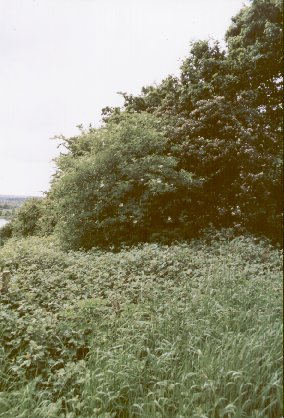
This old,
overgrown hedge on the southern edge of Hail Mary Hill Wood
supports a wide variety of wildlife.
|
BIRDS
Birds recorded in Hail Mary Hill and Falconer Woods reflect the
mix of habitats on the site. Birds preferring areas of more mature
woodland, often with standing deadwood, include Great-spotted Woodpecker,
Blackcap, Sparrowhawk and Tawny Owl. Wren and the summer vistors
Chiffchaff and Lesser Whitethroat prefer woodland edges and clearings
such as those associated with the power lines. Willow Tit, Reed
Warbler and Willow Warbler are associated with marsh and streamside
areas. The more open areas are also important, for example for displaying
Woodcock and feeding Jays.
For a number
of reasons, the bird fauna of Treeton Wood is less diverse than
that of its neighbour. Treeton Wood lacks the relatively wet conditions
found in parts of Hail Mary Hill Wood. The shrub layer is generally
under-developed and there is also a shortage of mature trees for
hole-nesting birds, as well as extensive areas of Birch, a tree
little used by breeding birds. Despite this, Treeton Wood does contain
a number of birds not already listed above. These include Green
Woodpecker, Redpoll, Whitethroat, Tree Pipit, Treecreeper, Yellowhammer,
Mistle Thrush, Long-tailed Tit, Song Thrush and Spotted Flycatcher.
The last two of these are of particular importance as they are relatively
infrequent and decreasing in numbers.
MAMMALS
A good variety
of mammals has been recorded in Hail Mary Hill and Falconer Woods,
including Fox, Pigmy Shrew, Field Vole, Bank Vole, Brown Hare and
Weasel. Harvest Mouse, Water Vole and Water Shrew have been recorded
from the marshland area. The site is also used as a feeding area
by Noctule and Pipistrelle Bats but although a number of suitable
trees are present, no bat roosts have ever been found.
More general information on the birds
and animals of the Heritage Woodlands is available elsewhere
on this website.
  
|