|
HAIL MARY
HILL & FALCONER WOODS - MANAGEMENT
INTRODUCTION
Management work at Hail
Mary Hill & Falconer Woods is undertaken by, or on behalf of,
Rotherham Metropolitan Borough Council who own the site.
TREES AND WOODLANDS
A major aim in both areas of woodland is to enhance their ancient
semi-natural character. A diverse structure with trees of differing
ages is being promoted by selective thinning of trees. This will
be carried out in such a way as to encourage native tree and shrub
species typical of the local area. Thinning will also have the effect
of extending the lifespan and improving the quality of selected
trees, such as mature Oaks and Sweet Chestnuts as well as encouraging
the development of a shrub layer and of a diverse ground flora.
Selected areas in both areas of woodland, particularly those under
power lines, might benefit from the reintroduction of coppicing
which, like thinning, would encourage native tree and flower species
by letting in light. It would also create a diverse habitat for
wildlife, in particular that preferring light but sheltered conditions.
NON-WOODED AREAS
Acid grassland areas such
as that on top of Hail Mary Hill and in the glade in Treeton Wood
will be kept free of invading trees and bracken as necessary.
Treeton Marsh
and its associated area of wet woodland will be managed to increase
their value to wildlife. This marsh area may be slowly silting up
and drying out, helped by the colonisation of Willow, Greater Reedmace,
Great Willowherb and the non-native and highly invasive species,
Himalayan Balsam. As a result, some control of these plants may
be required.
BIODIVERSITY
Both sites will be managed to conserve and promote their natural
history and to maintain or increase their populations of key plant
and animal, including the Purple Hairstreak butterfly, Song Thrush,
Spotted Flycatcher, Brown Hare and bats. To achieve this, the mixed
and semi-natural characteristics of the woodlands and other vegetation
will be promoted. Dead wood will be retained wherever possible for
its associated fungi, invertebrates, hole nesting birds and bats.
In Treeton Marsh, Reed Canary-grass will be encouraged to benefit
nesting Harvest Mice.
 |
|
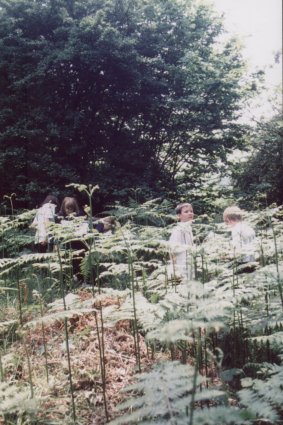
The children
working in this area of young Bracken fronds are on a guided
visit to Hail Mary Hill Wood as part of the Fuelling a Revolution
education programme.
|
HISTORY AND HERITAGE
Features of archaeological and historical interest on the two sites,
and in particular the Mesolithic site on Hail Mary Hill, will be
protected. Further research will be undertaken into the archaeology
of the two woodlands.
ACCESS AND RECREATION
Although both areas of
woodland provide a wide range of opportunities for enjoyment of
the countryside, the approach on access to the sites will be somewhat
different, with Treeton Wood being managed as a lower-key and more
informal recreational site.
Both sites are
being managed in order to provide safe and appropriate public access.
Formal access points and paths will be maintained and the use of
informal access points and paths will be discouraged. Undesirable
activities such as motorbike use, tipping, the abandonment of burnt-
out cars and hunting and shooting will also be discouraged. A particular
focus of the access work will be to provide access for less able-bodied
persons where this is practical.
The local community
are being encouraged to play a part in the care and management of
the woodlands. Events relating to the natural history and historic
interest of the sites are being held and educational use will be
continued and further encouraged, particularly in the case of Hail
Mary Hill and Falconer Woods.
MORE INFORMATION
More general
information on the management
of the woodlands and other habitats and on access
improvements is given elsewhere on this website.
  
|