|
HAIL MARY
HILL & FALCONER WOODS - EDUCATIONAL USE
INTRODUCTION
Because of its relatively easy access and variety of habitat types,
Hail Mary Hill and Falconer Wood provides considerable scope for
education work.
More detailed information to support education work in the wood
can be found in the Fuelling a Revolution education pack covering
Hail Mary Hill, Falconer and Treeton Woods. Details on how to obtain
this can be found in the Schools
section of this website.
SUGGESTED
ACTIVITIES FROM THE SCHOOLS SECTION OF THIS WEBSITE
The Schools section of this
website provides units of work covering a wide range of subject
areas and Key Stages. Although, all or most of these units, would
be suitable for use inHail Mary Hill & Falconer Woods, some
are particularly appropriate, and for this reason, direct links
to these downloadable materials are provided below.
Key Stage 1 Maths - 'Looking
at Leaves'
All of the tree species shown on the pupil sheet
can be found in the two woodlands.
Key Stage 1 Science - 'Plants
and Animals'
The wildlife
of non-wooded areas such as the grassland on Hail Mary Hill could
be compared to a nearby area of woodland.
Key Stage 1 Science - 'Variation'
The range of different habitats in Hail Mary Hill
Wood makes it ideal for comparing the different characteristics
of a wide range of animal species.
Key Stage 1 Geography- 'Our
Local Wood'
Being situated close to residential areas, the two woodlands could
form part of a route around the local area looking at different
land uses.
 |
|
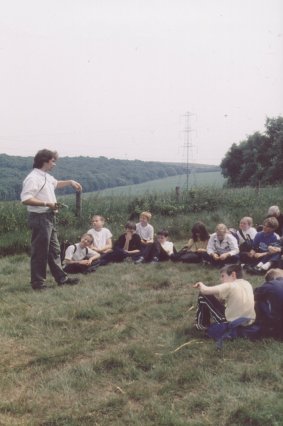
A guided
school visit on the summit of Hail Mary Hill.
|
Key Stage 2 Literacy - 'Read
All About It'
Devise a leaflet telling users of Hail Mary Hill and Falconer Woods
about the woodland and describing what they might see when following
the trail provided in this pack.
Key Stage 2 Numeracy - 'Girth
& Gaps'Well established more open areas of woodland
such as that at point 3 on the trail could be compared to denser
areas of younger trees, for example that around point 7 on the trail.
Key Stage 2 Science - 'What
Lives Where?'
The range of vegetation types on the site provides an ideal resource
for studying where on the site animals might find shelter, water,
air and food.
Key Stage 2 Science - 'Life
Cycles'
The range of ages of trees on the site makes it ideal for the study
of changes during a tree's life cycle, from seed through sapling
and mature tree to old age, death and decay.
Key Stage 2 Geography -
'Pictures and Plans'
The view across Treeton Dyke to opencasting work
on the old Orgreave Colliery tip could be examined using the pupil
sheet from this unit, with the area being first drawn as it is now,
and then as the pupils would like to see it in five years time.
Key Stage 2 Geography - 'Do
you come here often?'
Hail Mary Hill and Falconer Woods in particular are used for a wide
range of recreational uses including walking, mountain biking and
horse riding. In addition, the open water area of Treeton Dyke provides
opportunities for angling, boating and water skiing. Study the range
of different recreational activities taking place and consider potential
conflicts between these and their possible effects on the site.
Key Stage 2 Art - 'Signposts'
Design signposts and trail markers for the trail in this pack or
for the horse riding route through Hail Mary Hill and Falconer Woods.
Key Stage 3
Science - 'Woodland Survival'
Examples of all of the different adaptations to woodland
life listed on the pupil sheet can be found at the two sites, in
particular at Hail Mary Hill and Falconer Woods.
Key Stage 3 Science - 'Are
All Woods the Same?'
This unit of work could be used to compare the fauna and flora of
different areas of the site, for example younger and more mature
areas of woodland or the adjacent wet and dry areas of woodland
close to point 13 on the trail.
Key Stage 3 Geography -
'Woodland Climates'
Open and more dense areas of woodland, clearings under power lines,
and open areas of ground such as that on Hail Mary Hill could be
compared in terms of their local climate. The effect of proximity
to the open water area of Treeton Dyke could also be investigated.
Key Stage 3
Art & Design - 'Recreating
Woodlands'
Views of the woodlands themselves could be combined with views from
the shores of Treeton Dyke and from the summit of Hail Mary Hill
to provide a starting point for work conveying mood and feeling
about the landscape.
In addition, other useful resources from the Fuelling a Revolution
education packs and from 'get, set... Grow', the South Yorkshire
Forest schools' pack, can be downloaded from Downloadable
Pupil and Teacher Resources for Key Stage 2 in the Schools section
of this site.
The 'Tree File' CD ROM that accompanies the 'get, set... Grow'
pack contains identification details and background information
for all of the major tree and shrub species found in the wood including
Alder, Ash, Beech, Birch, Field Maple, Guelder Rose, Hawthorn, Hazel,
Oak, Rowan, Sweet Chestnut, Sycamore, and Whitebeam. For further
information, go to the section on printed
education materials in the Schools section of this website.
OTHER
ACTIVITIES
Key Stage 3 Science
Study the colonisation
of the acid grassland area on Hail Mary Hill or the glade in Treeton
Wood by Bracken, scrub and woodland.
Set up a line
transect or series of metre square quadrats from the centre of an
open area into an adjacent area of woodland and record using a cross-section
diagram.
  
|