|
SCHOLES
COPPICE & BRAY PLANTATION - MANAGEMENT
INTRODUCTION
Management work in the
two woodlands is undertaken by, or on behalf of, Rotherham Metropolitan
Borough Council, the site owners.
A management
plan was first prepared for Scholes Coppice in 1993. The most recent
management plan for the site was prepared in 2002 as part of the
Fuelling a Revolution programme.
TREES
AND WOODLANDS
Until 1993, the
majority of Scholes Coppice had been unmanaged for several decades.
As a result, the plantation areas in particular were in a very poor
condition, with very few young trees and with ancient woodland indicator
plants being lost because of the dense shade cast by the trees.
 |
|
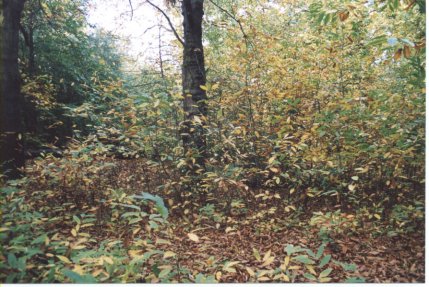
Dense regrowth
of Sweet Chestnut in an area where felling of large trees
has taken place in the recent past.
|
In 1994, a programme
of woodland management was reintroduced; the mature trees in a number
of small areas being felled in order to let light reach the woodland
floor. The result of this is now visible in the form of greatly
increased growth of young trees which will ultimately become replacements
for the aging trees in the woodland canopy. The aim of this work
is to encourage the development of a woodland with trees of a variety
of ages and sizes and a mix of species, especially of native trees
such as Oak, Birch, Hazel, Ash and Wild Cherry. The work will also
extend the lifespan and improve the quality of some of the better
formed existing trees and has also resulted in considerable benefits
for wildlife. Similar work is now continuing in places in the form
of selective thinning and group felling of Beech, Sweet Chestnut
and Sycamore.
Outside the
plantation areas, work will be directed at maintaining and strengthening
the character of the more semi-natural parts of the site. Some thinning
and group-felling will be carried out in order to extend the life
of the best formed trees, in particular, of Oak, Beech and Ash,
and to promote regeneration of young trees. The non-native species,
Sycamore will be particularly favoured for removal. The central
area, with its 30 - 40 year old Oak and Birch trees, together with
the narrow woodland extension along Scholes Lane may also benefit
from thinning. Apart from this, these areas will largely be left
alone in order to preserve them as a wildlife refuge, in particular
for breeding birds.
Although Scholes
Coppice was once managed as coppice woodland, there is no surviving
coppice within the woodland today. Reintroduction of coppicing other
major parts of the site would be unrealistic because of the present
woodland structure and the relative absence of typical coppiced
shrubs such as Hazel. However, coppicing will be carried out along
the edge of Raspberry Plantation in order to provide a graded margin
from mature woodland to farmland which will form a a structurally
diverse habitat for wildlife, including several of the priority
bird species breeding at the site. Similarly,
some of the other woodland edges will be managed so that they grade
into adjacent areas of open space, something that benefits the birds
and animals that live in this important 'edge habitat'.
NON-WOODED AREAS
The two small wetland
areas at the northernmost tip of the site are an example of an important
and rapidly disappearing habitat. They will be left largely unmanaged
in order to avoid unnecessary disturbance to the wildlife associated
with them.
The gradual
removal of mature trees from Caesar's Camp over the next 15 years
to protect the ancient monument will create a permanent glade within
the woodland. This will be maintained as an open grassy area with
scattered scrub, providing an additional habitat supporting more
light demanding woodland edge species.
Similarly, the
glade in the northern part of Bray Plantation will be kept open
by the periodic removal of invading trees and shrubs meaning that
it retains its value for light-demanding plants and the invertebrates
associated with these.
BIODIVERSITY
In order to assist in
the preservation of its wildlife, Scholes Coppice and the adjoining
flower-rich grassland of Keppel's Field were designated as a Local
Nature Reserve in 1996. The site supports several animal species
protected under the 1981 Wildlife and Countryside Act.
Both woods will
be managed to conserve and enhance their natural history and to
maintain or increase their populations of key plants and animals.
The latter include Hare, two species of bat, Song Thrush, Linnet
and Bullfinch and a number of invertebrates including the butterflies,
Comma, Purple Hairstreak, Holly Blue and Speckled Wood and at least
seven species of moth. Particular attention will be paid to the
management of areas used by these species. These include the ponds
and wet woodland areas and the central area Scholes Coppice which
will be left largely unmanaged. In order to minimise disturbance
to the wildlife, access to these areas will also be discouraged.
A varied woodland
structure is important for invertebrates, with well developed field
and shrub layers and a mixed height canopy providing a greater range
of opportunities than even-aged structurally uniform woodland. Encouraging
the development of shrubs will help populations of both invertebrates
and birds. Both standing and fallen deadwood are of value as a habitat
for fungi, invertebrates, hole-nesting birds and bats and wherever
possible, these will be retained.
In order to
provide further information on the wildlife of the woods, further
surveys of the area's fungi, mosses, invertebrates, birds and bats
will be undertaken.
HISTORY AND HERITAGE
Work will take place to
protect features of archaeological and historic interest.
Foremost among
these is the Iron Age site of Caesar's Camp, a Scheduled Ancient
Monument. This has, in recent years, suffered from inappropriate
recreational use, including the riding of mountain bikes and motorbikes.
There is also concern about the damage being caused by mature trees
growing on the earthwork. Over the next five years, it is hoped
to have the existing dedicated footpath crossing the monument re-routed
in order to further reduce erosion of the site.
Further research
will be undertaken into the archaeology of the woodlands, following
which features of archaeological and historical interest will be
preserved as appropriate.
ACCESS AND RECREATION
Both Scholes Coppice and
Bray Plantation are popular places for both formal and informal
recreation. Walking is probably the most common informal activity
taking place but other activities include mountain biking, horse
riding, natural history study, environmental education and motor
cycling.
Since 1990,
all the formal access points into the woodlands and Keppel's Field,
have been provided with gates or stiles, including at the Willows
entrance, a disabled access stile. These formal access points will
continue to be maintained whilst the use of other informal access
points is discouraged through the strengthening of existing boundaries.
Hopefully these renewed boundaries will continue to help to deter
motorcyclists and those responsible for fly tipping and the abandonment
of burnt out cars. They will also keep out grazing animals that
might eat young trees.
Similarly, official
paths and bridleways within the woods will be maintained and waymarked
with the use of other casual footpaths being discouraged in order
to reduce disturbance to the site and its wildlife. A particular
focus of access work will be to provide access for less able-bodied
persons where this is practical.
Alongside this
access work, the community around the woodlands will be actively
encouraged to become involved in the care and management of the
woodlands and in its enjoyment of wildlife and the countryside.
The local community will continue to be consulted and kept informed
about the management of the woodlands and will also be encouraged
to play a practical role in the management of the site, both by
taking part in practical management tasks and by keeping an eye
on the woodland. A group, 'Friends of Scholes Coppice' currently
exists to pursue such work..
The potential
of the site as an educational and environmental arts resource is
being developed through guided walks, events relating to the natural
history and historic interest of the site, children's events and
practical management tasks as well as by the production of leaflets
and this education pack.
MORE INFORMATION
More general information on the management
of the woodlands and other habitats and on access
improvements is given elsewhere on this website.
  
|